
Quick Answer
Interment means the act of placing a deceased person’s body or cremated remains in a final resting place, such as a grave, cemetery, mausoleum, or columbarium. The word is commonly used in formal, funeral, cemetery, and historical contexts. For example, the sentence “The interment will take place after the funeral service” means that the deceased will be placed in their final resting place after the service.
Key Takeaways
- Interment refers to the formal placement of a deceased person’s body or remains in a final resting place.
- It is commonly associated with burial and funeral arrangements.
- The term can refer to placing remains in a grave, mausoleum, vault, or columbarium.
- Interment is a noun, while inter is the related verb.
- The word is generally more formal than simply saying burial.
- Interment can involve either a traditional burial or the placement of cremated remains.
What Does Interment Mean?
The word interment refers to the act or process of placing a deceased person’s remains in a designated final resting place. In traditional circumstances, this usually means placing the body in a grave. However, interment is not limited to underground burial. It can also describe placing remains inside a mausoleum, burial vault, crypt, or another permanent resting place.
The term is often found in funeral announcements, cemetery records, obituaries, historical documents, and formal descriptions of burial arrangements. Because it has a formal tone, people may encounter it in phrases such as “interment services,” “place of interment,” or “following interment.”
In simple English, you can usually understand interment as the formal placing of a deceased person’s remains in their final resting place.
Interment Definition
A straightforward definition of interment is:
Interment is the act of placing a deceased person’s body or cremated remains in a final resting place.
The final resting place may be a traditional grave, mausoleum, crypt, burial vault, or another location specifically intended for the permanent keeping of human remains.
The word focuses on the act of placement, rather than the entire funeral ceremony. A funeral service may happen before interment, while a memorial gathering may occur separately. The exact order and customs depend on cultural, religious, and family traditions.
What Is the Difference Between Interment and Burial?
Interment and burial are closely related, but they are not always identical in usage.
Burial commonly refers to placing a deceased person’s body in the ground. It is the everyday word most people use when talking about this process. Interment, on the other hand, is a more formal term that describes placing human remains in a final resting place. That resting place does not necessarily have to be an underground grave.
For example, placing a body in a cemetery grave can be described as both a burial and an interment. Placing remains inside a mausoleum may be called interment, even though the remains are not buried directly in the ground.
Therefore, burial is often one type of interment, while interment can be a broader formal term.
Interment vs. Inurnment
The terms interment and inurnment can sometimes be confused because both relate to the final placement of human remains.
Interment is a broad term that can refer to placing a deceased person’s body or remains in a final resting place. Inurnment specifically refers to placing cremated remains inside an urn or placing that urn in its designated final location.
For instance, if cremated remains are placed in a cemetery niche or mausoleum, the process may be described as inurnment. The broader concept of placing remains in a permanent resting place can also be discussed as interment.
The distinction is useful when reading funeral or cemetery terminology, although everyday speakers may not always make a strict distinction.
What Does Interment Mean in a Funeral?
In a funeral context, interment refers to the part of the arrangements in which the deceased person’s body or remains are placed in their final resting place.
A funeral may include several different stages. Family members and friends might attend a viewing or visitation, followed by a funeral or religious service. Afterward, those attending may proceed to a cemetery for the interment.
An interment ceremony may be brief and private or may include prayers, readings, religious traditions, military honors, or remarks from family members. The ceremony itself can vary greatly depending on personal wishes, culture, religion, and local customs.
What Is an Interment Ceremony?
An interment ceremony is a gathering or service held when a deceased person’s remains are placed in their final resting place. It may take place at a cemetery, mausoleum, memorial park, or another appropriate location.
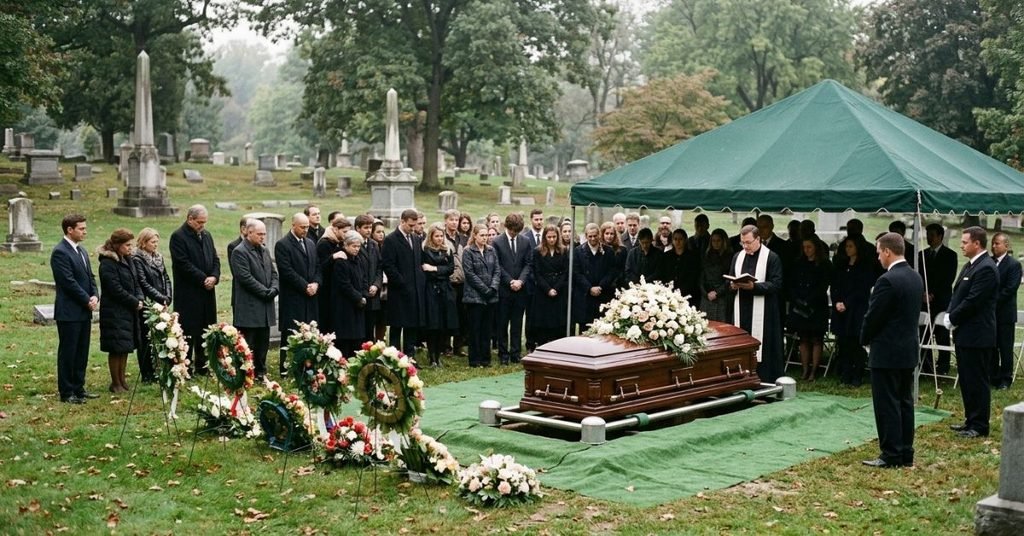
Some interment ceremonies are simple and intimate. Others may include formal religious or cultural traditions. A ceremony might involve prayers, readings, music, a moment of silence, or words from family members.
The interment ceremony does not necessarily have to be the same as the funeral service. In many cases, the funeral and interment are separate parts of the overall farewell.
Common Examples of Interment
Here are several examples that show how the word interment is commonly used:
- The family gathered at the cemetery for the interment.
- Interment will follow the funeral service.
- The notice included details about the location of the interment.
- The family requested a private interment.
- His interment took place in the family cemetery.
- The cemetery prepared the site for the interment.
- The service concluded with the interment of the remains.
- The date of interment was announced by the family.
These examples demonstrate that the word is generally used when discussing the formal placement of remains.
Interment in a Sentence
The word interment is normally used as a noun. It often appears in formal statements about funeral or cemetery arrangements.
For example:
“The interment is scheduled for Saturday afternoon.”
Here, interment refers to the planned placement of the deceased person’s remains.
Another example is:
“The family attended the private interment following the memorial service.”
In this sentence, interment describes the private final-placement ceremony that occurred after the memorial service.
A historical example could be:
“The records provide the date and location of his interment.”
In this case, the word refers to where and when the person’s remains were placed.
Common Phrases With Interment
Because interment is a formal word, it often appears in particular phrases. “Interment services” can refer to services associated with placing remains in their final resting place. “Place of interment” means the location where the remains were or will be placed. “Interment will follow” is commonly used in funeral notices to indicate that the placement of remains will occur after another service.
Other possible expressions include “private interment,” “family interment,” “interment ceremony,” and “interment arrangements.” These phrases are especially common in formal funeral notices, cemetery documentation, and historical records.
Also Read! Subaru Meaning: What Does Subaru Mean and Where Does the Name Come From?
Is Interment the Same as Cremation?
No. Interment and cremation describe different parts of the process.
Cremation is a process in which a person’s body is reduced to cremated remains using high heat. Interment refers to the subsequent or separate act of placing a body or remains in a final resting place.
For example, a person may be cremated and their ashes may later be placed in an urn niche, cemetery plot, mausoleum, or another designated location. That final placement can be described as interment.
This means cremation and interment are not interchangeable terms. One describes the treatment of the body, while the other describes its final placement.
Is Interment a Formal Word?
Yes. Interment is generally considered a formal term. You are more likely to see it in funeral notices, cemetery records, legal or administrative documents, obituaries, historical writing, and professional funeral-service language than in casual everyday conversation.
In ordinary conversation, someone might simply say:
“The burial will be on Friday.”
A formal notice might instead say:
“Interment will follow the funeral service.”
Both can communicate a similar idea, but interment has a more formal and respectful tone.
What Is the Verb Form of Interment?
The related verb is inter.
To inter someone means to place their remains in a final resting place.
For example:
“He was interred in the family cemetery.”
The noun form is interment:
“His interment took place in the family cemetery.”
These words are closely connected, so recognizing both can make formal funeral and historical writing easier to understand.
Interment Meaning in Obituaries
The word interment frequently appears in obituaries and death notices when information about final arrangements is provided.
For example, an obituary might state that interment will be private. This means the family intends to keep the final placement of the deceased person’s remains limited to family members or selected guests.
An obituary may also say that interment will follow the service. This tells readers that the deceased will be placed in their final resting place after the funeral or memorial service.
Because obituaries often use formal language, interment is a natural word in this context.
Interment Meaning in Historical Contexts
Interment is also common in historical writing. When historians, genealogists, or researchers discuss where a person was buried or where their remains were placed, they may use terms such as interment and interred.
For example:
“The historical record lists the date of his interment.”
This wording simply identifies when the person’s remains were placed in their final resting place.
The term may also appear on old cemetery records, memorial inscriptions, genealogical documents, and historical biographies.
Why Do People Use the Word Interment?
People use interment because it provides a precise and respectful way to describe the final placement of human remains. It is especially useful in situations where burial might be too narrow or informal.
The term also works across different types of final resting places. Whether remains are placed in a grave, mausoleum, crypt, or another designated location, interment can describe the act without focusing on one particular method.
Its formal tone also makes it appropriate for official announcements and funeral documentation.
Simple Meaning of Interment
If you want to remember the meaning quickly, think of:
Interment = placing a deceased person’s remains in their final resting place.
For everyday understanding, you can often think of it as formal burial or final placement of remains.
For example, if someone says:
“The interment will take place after the ceremony,”
they mean that the deceased person’s remains will be placed in their final resting place after the ceremony.
Also Read! What Does “Foid” Mean? Understanding a Toxic Corner of Internet Slang
Final Thoughts
The word interment refers to the formal act of placing a deceased person’s body or cremated remains in a final resting place. Although it is closely associated with burial, its meaning can be broader because the final location may be a grave, mausoleum, crypt, vault, or another designated place.
You will most often encounter interment in funeral announcements, obituaries, cemetery records, historical documents, and other formal writing. Understanding the distinction between interment, burial, cremation, and inurnment can make these terms much easier to interpret.
In the simplest terms, interment means the final placement of a deceased person’s remains.
Frequently Asked Questions About Interment
1. What does interment mean in simple words?
Interment means placing a deceased person’s body or cremated remains in a final resting place. This may be a grave, mausoleum, crypt, burial vault, or another designated location.
2. Is interment the same as burial?
Interment and burial are closely related, but they are not always exactly the same. Burial usually refers to placing a body in the ground, while interment is a broader and more formal term for placing remains in a final resting place.
3. What happens during an interment?
During an interment, the deceased person’s body or remains are placed in their chosen final resting place. Depending on the family’s wishes and traditions, the process may include prayers, readings, religious customs, military honors, or a brief ceremony.
4. Does interment happen before or after a funeral?
Interment commonly takes place after a funeral or memorial service, although the order can vary. Funeral arrangements depend on the family’s preferences, cultural traditions, religious practices, and the type of service being held.
5. Can cremated ashes be interred?
Yes. Cremated remains can be interred in an appropriate permanent location. For example, an urn containing ashes may be placed in a cemetery, mausoleum, columbarium, or another designated resting place.
6. What is the difference between interment and cremation?
Cremation is the process used to transform a deceased person’s body into cremated remains. Interment refers to placing a body or remains in a final resting place. Therefore, cremation and interment describe two different parts of the final arrangements.
7. What is the verb form of interment?
The verb form is inter. To inter someone means to place their remains in a final resting place. For example, “He was interred in the family cemetery” means that his remains were placed there.




[…] Also Read! Interment Meaning: Definition, Examples, and Common Uses […]