The Hamsa is one of the world’s most recognizable spiritual symbols, known for its distinctive hand-shaped design, deep cultural roots, and association with protection, good fortune, and positive energy. Often displayed as jewelry, wall art, decorative ornaments, and meaningful tattoos, the Hamsa has remained an important symbol across generations and cultures.
At first glance, the Hamsa may look like a simple open hand, sometimes featuring an eye in its palm. However, its meaning extends far beyond its appearance. For many people, it represents protection against the evil eye, a reminder of faith, a symbol of peace, and a meaningful expression of hope and spiritual awareness.
But what does the Hamsa really mean? Where did it originate, why is it associated with the evil eye, and what do its different designs represent?
Understanding the Hamsa requires looking at its history, cultural interpretations, spiritual associations, and the ways people use it in everyday life. Although its precise origins and meanings are interpreted differently across traditions, its enduring appeal lies in its association with safety, resilience, and the desire for a more peaceful and fortunate life.
What Is the Meaning of Hamsa?
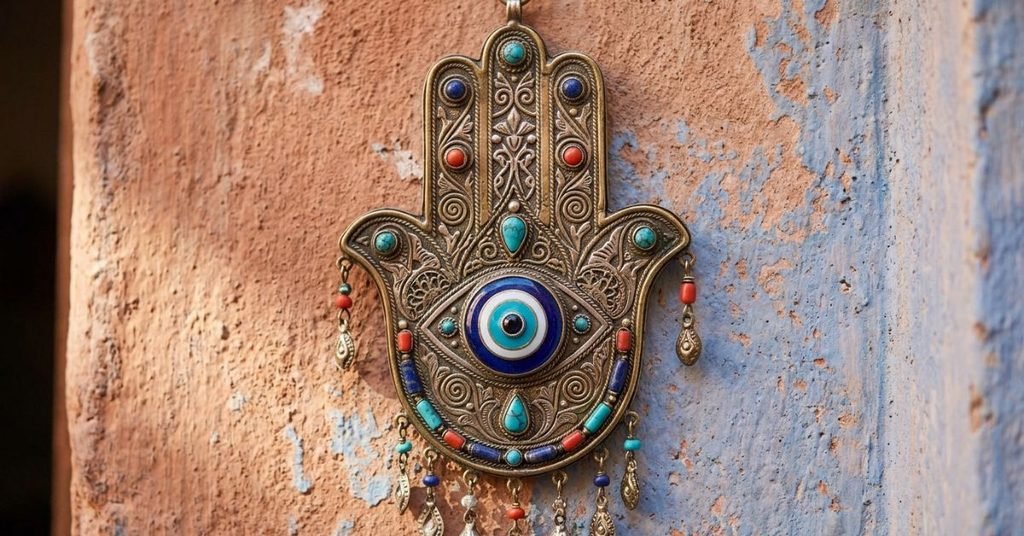
The Hamsa is a hand-shaped symbol traditionally associated with protection, good fortune, blessings, and defense against negative influences. It is commonly depicted as an open palm with five fingers, often arranged symmetrically, with a distinctive thumb and little finger curving outward.
Many Hamsa designs include an eye in the center of the palm. This eye is particularly associated with protection against the evil eye, a traditional belief that envy or a malicious gaze can bring misfortune.
The Hamsa’s meaning can vary depending on the culture, religion, and personal beliefs of the person who uses it. For some, it is a sacred emblem connected to religious heritage. For others, it is a cultural symbol or a personal reminder to remain hopeful, mindful, and grounded.
The most common meanings associated with the Hamsa include:
- Protection: A symbolic defense against the evil eye, envy, and harmful intentions.
- Good fortune: A representation of luck, prosperity, and favorable opportunities.
- Blessings: An expression of the desire for safety, happiness, health, and abundance.
- Peace and harmony: A reminder to seek balance within oneself and in relationships.
- Faith and spirituality: A meaningful symbol connected to religious traditions and spiritual identity.
- Strength and resilience: An open hand can represent courage, confidence, and the ability to face life’s challenges.
It is important to understand that these meanings are symbolic and culturally grounded. Wearing a Hamsa does not guarantee protection or good luck, but many people find comfort, identity, and personal meaning in the symbol.
What Does the Word Hamsa Mean?
The word Hamsa is commonly associated with the Arabic word khamsa, meaning “five.” This refers to the five fingers of the human hand and explains why the number five is an important feature of the symbol.
The number five carries different associations across cultures. In some traditions, it is connected to religious observance, spiritual remembrance, or the human hand as an emblem of blessing and protection.
The symbol is also known by different names, depending on the cultural context in which it appears.
- Hand of Fatima: A name widely associated with the Hamsa in Muslim cultural traditions, referring to Fatima, the daughter of the Prophet Muhammad.
- Hand of Miriam: A name used in Jewish tradition, referring to Miriam, the sister of Moses and Aaron.
- Hand of Mary: A name sometimes used in Christian contexts, particularly in parts of the Middle East and Mediterranean region.
- Khamsa: A spelling closely reflecting the Arabic word for five.
These names are not simply interchangeable labels. Each reflects a particular cultural or religious interpretation of the hand, demonstrating how a similar visual symbol can carry different layers of meaning.
The History and Origins of the Hamsa Symbol
The history of the Hamsa is complex because hand-shaped protective motifs have appeared in different ancient cultures. Scholars do not identify one universally agreed origin for every form of the symbol used today.
Hand imagery has a long history across the ancient Mediterranean and Middle East, where hands could represent authority, blessing, divine power, or protection. Over time, hand-shaped amulets and related motifs became part of the artistic and spiritual traditions of various communities.
The Hamsa as it is widely recognized today is especially associated with North African and Middle Eastern cultures, including Jewish and Muslim communities. Its development reflects centuries of cultural exchange, migration, artistic influence, and shared regional traditions.
The Hamsa in Ancient Traditions
Open-hand motifs existed in the ancient world long before the Hamsa became a familiar modern decorative symbol. In different settings, a raised or open hand could communicate blessing, power, or protection.
Some historical discussions connect later Hamsa imagery with ancient Near Eastern protective motifs. However, the precise relationship between those early images and the modern Hamsa is not always clear, and it would be inaccurate to claim that every historical hand symbol represents the same uninterrupted tradition.
What makes the Hamsa particularly interesting is its ability to acquire and preserve meaning across different cultural environments.
The Hamsa in North African and Middle Eastern Cultures
The Hamsa became particularly prominent in North African and Middle Eastern decorative and amuletic traditions. In some communities, it was displayed in homes or worn on the body as a symbol intended to ward off misfortune and the evil eye.
Jewish and Muslim communities have both incorporated Hamsa imagery into their cultural practices, although the interpretations, accompanying prayers, and religious attitudes toward amulets can differ.
Its popularity also reflects the widespread cultural importance of the evil eye belief, which appears in many societies around the world. In these settings, protective objects are often understood as reminders of spiritual care, good intentions, or the hope of remaining safe from envy and harm.
The Hamsa in the Modern World
Today, the Hamsa appears in jewelry collections, home décor, fashion accessories, artwork, and wellness-inspired designs. Its meaning has expanded beyond traditional amulet use, and people from many backgrounds wear or display it.
Some people value the Hamsa because of their religious or cultural heritage. Others appreciate its artistic design or interpret it as a personal symbol of peace, courage, and protection.
Despite its widespread modern popularity, the Hamsa retains strong associations with the cultures in which it has been used for generations.
Also Read! Edelweiss Meaning: Symbolism, Origin, and Cultural Significance
What Does the Hamsa Eye Mean?
One of the most recognizable versions of the Hamsa features an eye in the center of the palm. This combination is often called the Hamsa eye and is strongly associated with protection against the evil eye.
The evil eye is a traditional belief that an envious or harmful gaze may bring bad luck, distress, or misfortune. Similar beliefs appear across the Mediterranean, the Middle East, South Asia, and other regions, although their expressions differ.
Within this cultural framework, the eye on the Hamsa serves as a protective emblem. It is often interpreted as a symbol that watches over the wearer or helps deflect harmful intentions.
The eye may also carry broader symbolic meanings, such as:
- Awareness of one’s surroundings.
- Mindfulness and spiritual attentiveness.
- The desire to remain safe from jealousy and negativity.
- The importance of protecting one’s peace and well-being.
Different designs use different colors and styles for the eye. Blue is particularly common in protective amulets associated with the evil eye, but there is no single color or design required for a Hamsa to carry meaning.
The Hamsa eye should not be confused with a universal religious doctrine. It belongs to a broader landscape of folk beliefs, artistic traditions, and personal spiritual interpretations.
The Spiritual Meaning of the Hamsa
The spiritual meaning of the Hamsa depends on the tradition and intention behind its use. For many people, it represents the hope of living under protection, receiving blessings, and maintaining a peaceful relationship with the world.
Rather than having one universally accepted spiritual definition, the Hamsa brings together several themes that different communities emphasize in their own ways.
Protection From Negative Energy
Protection is perhaps the most widely recognized association of the Hamsa. People may wear it as a pendant, place it near a doorway, or keep it as a personal keepsake.
In traditional interpretations, the symbol helps guard against envy, the evil eye, and misfortune. In a more personal or contemporary interpretation, it can serve as a reminder to establish boundaries, avoid unnecessary negativity, and protect one’s emotional well-being.
Blessings and Good Fortune
The Hamsa is also associated with blessings and good fortune. It may be given as a gift to celebrate a new home, a marriage, a new beginning, or another important milestone.
In these situations, the symbol communicates a wish for happiness, safety, prosperity, and success.
Its meaning is often less about predicting the future and more about expressing goodwill toward someone embarking on a new chapter of life.
Peace and Emotional Balance
The open hand can be interpreted as a gesture of openness, generosity, and peace. For some people, the Hamsa represents the intention to approach life with patience rather than fear and to remain grounded during difficult experiences.
This interpretation is especially relevant to people who use symbols as part of their personal reflection or mindfulness practices.
Faith and Spiritual Connection
For others, the Hamsa has meaning because of its connection to a specific religious or cultural heritage. Its significance may come from family traditions, community history, or the religious associations of the Hand of Fatima or Hand of Miriam.
In these contexts, the symbol can serve as a visible connection to identity, belonging, and inherited tradition.
Hamsa Meaning in Islam: The Hand of Fatima
In Muslim cultural traditions, the Hamsa is widely known as the Hand of Fatima, referring to Fatima, the daughter of the Prophet Muhammad.
The symbol is commonly associated with protection, blessings, patience, and family well-being in various Muslim communities. It is also connected in popular culture to the desire to guard against the evil eye.
However, an important distinction must be made: the Hamsa is not a universal Islamic religious symbol, and its use is not prescribed as a protective object in the Qur’an. Muslim beliefs and practices regarding amulets vary, and some Islamic scholars object to relying on objects for supernatural protection.
For Muslims, protection is fundamentally connected to Allah, and practices involving the evil eye and protective objects are understood differently across communities.
Consequently, the Hand of Fatima is best understood as a symbol with an important place in some Muslim cultural traditions, rather than an object with a single universally accepted religious status.
Hamsa Meaning in Judaism: The Hand of Miriam
In Jewish tradition, the Hamsa is often known as the Hand of Miriam, referring to Miriam, the sister of Moses and Aaron. It is especially familiar in Jewish communities with North African and Middle Eastern heritage.
The Hamsa is frequently associated with protection against the evil eye, blessings, good fortune, and the desire for peace within the household.
It may appear in jewelry, decorative wall hangings, ceremonial gifts, and other objects associated with Jewish cultural life.
Some designs incorporate Hebrew letters, words of blessing, or other Jewish symbols. These additions can make the Hamsa a more explicitly Jewish expression of faith and cultural identity.
As with other traditions, Jewish interpretations differ. Some people regard it primarily as a cultural emblem, while others attach spiritual significance to it. Its presence in Jewish culture does not mean that every Jewish person uses or believes in its protective power.
Hamsa Meaning in Christianity
The Hamsa also appears in some Christian communities, particularly in parts of the Middle East and the wider Mediterranean region. In these contexts, it may be called the Hand of Mary, referring to Mary, the mother of Jesus.
The symbol can represent maternal care, blessings, protection, and the hope that a household will experience peace and well-being.
Its use illustrates the cultural overlap that can occur among communities living in the same region over long periods. Similar motifs may appear in neighboring religious traditions while acquiring distinct interpretations.
The Hamsa is not a universal Christian religious emblem, however, and it should not be confused with symbols that are central to Christian doctrine, such as the cross.
Also Read! Interment Meaning: Definition, Examples, and Common Uses
What Does an Upward-Facing Hamsa Mean?
The direction of the Hamsa is often discussed in modern spiritual and jewelry traditions.
An upward-facing Hamsa generally has its fingers pointing toward the sky. It is commonly interpreted as a symbol of protection, strength, boundaries, and resistance to harmful influences.
The raised hand may also suggest the familiar gesture of saying “stop,” making it a natural symbol for the intention to keep negativity at a distance.
People who choose this design may associate it with:
- Protection against the evil eye.
- Strength and personal boundaries.
- Courage during challenging situations.
- Awareness and mindfulness.
These interpretations are common in contemporary explanations of the symbol, but they are not universal rules shared by every historical or religious tradition.
What Does a Downward-Facing Hamsa Mean?
A downward-facing Hamsa typically has its fingers pointing toward the ground. In many modern interpretations, this version is associated with abundance, blessings, fertility, gratitude, and welcoming good things into one’s life.
Some people interpret the downward-facing hand as an invitation to receive positive experiences, appreciate everyday blessings, or remain open to new opportunities.
It may also be used as a symbol of generosity, suggesting the idea of giving blessings rather than merely receiving them.
However, the distinction between upward-facing and downward-facing Hamsa designs is not consistent across all cultures. Some traditions use the same symbol in either direction without assigning a strict difference in meaning.
Therefore, the orientation can be a helpful personal preference, but it should not be treated as a universal spiritual law.
What Do the Five Fingers of the Hamsa Represent?
Because the Hamsa is shaped like a hand, its five fingers are central to its identity. The number five also provides the connection to the word khamsa.
There is no single universally accepted meaning for each individual finger. Instead, the five fingers are interpreted in several ways depending on the cultural or spiritual context.
Five as a Symbol of Protection
The five fingers collectively form a recognizable emblem of the hand, which is associated with protection and blessing in many Hamsa traditions.
In some modern spiritual interpretations, the number five is also treated as a reminder to remain aware of one’s surroundings and intentions.
Five as a Reminder of Religious Practice
In Islamic cultural interpretations, the number five may evoke the Five Pillars of Islam. Nevertheless, this association should not be taken to mean that the Hamsa itself is a required Islamic symbol or that all Muslims understand it this way.
In Jewish contexts, some people associate the five fingers with religious ideas connected to the number five, although interpretations vary.
Five as a Personal Symbol
Outside religious contexts, the five fingers may represent balance, unity, or the connection between the physical body and personal intentions.
Someone might use the Hamsa as a reminder to act kindly, protect their peace, express gratitude, and approach everyday decisions thoughtfully.
These personal meanings can be valuable without requiring the belief that each finger possesses a separate supernatural power.
Hamsa Meaning in Jewelry
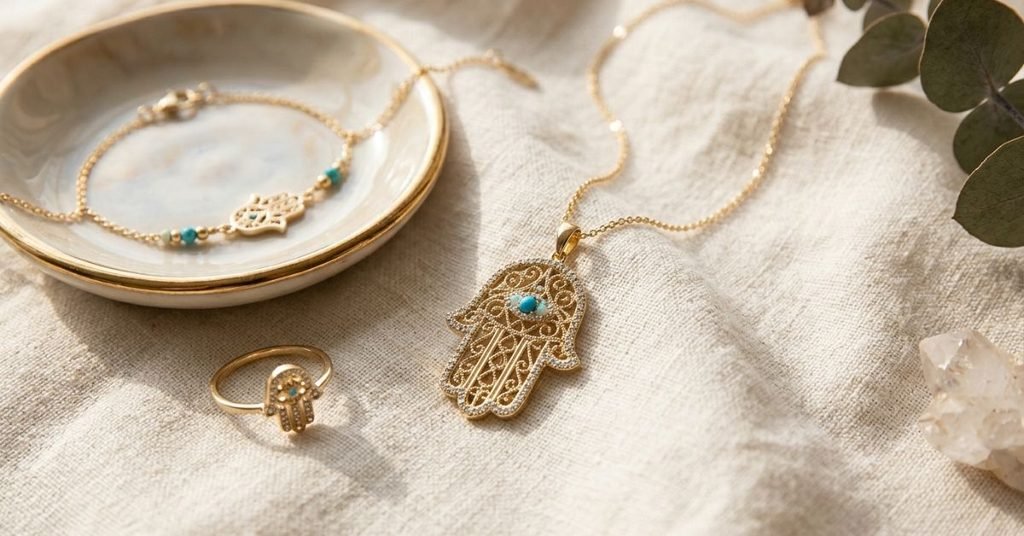
Hamsa jewelry is popular because it combines a distinctive visual design with a meaningful symbolic history. Necklaces, bracelets, rings, earrings, and charms allow people to carry the symbol with them throughout the day.
Hamsa Necklace Meaning
A Hamsa necklace often represents personal protection, blessings, or a connection to cultural heritage. Because it is worn close to the body, some people view it as a private reminder of faith, resilience, or the intention to remain peaceful.
A necklace may also be given as a thoughtful gift to someone beginning a new job, moving to a new home, or entering another important stage of life.
Hamsa Bracelet Meaning
A Hamsa bracelet can serve as a daily reminder of protection and positive intentions. Its meaning may be spiritual, cultural, decorative, or a combination of these.
Some bracelets include beads associated with evil eye traditions, creating a design that combines two familiar protective motifs.
Hamsa Ring Meaning
A Hamsa ring can symbolize confidence, personal strength, and a connection to a particular spiritual or cultural tradition.
For some wearers, it represents the intention to make thoughtful choices and maintain healthy boundaries. Others simply appreciate its craftsmanship and historical associations.
Hamsa Jewelry as a Gift
Hamsa jewelry can be a meaningful gift when its cultural background is understood and respected. It is often chosen to express wishes for safety, happiness, and prosperity.
Because the symbol has different meanings across communities, it can be thoughtful to explain why you chose it or to consider the recipient’s own beliefs and cultural preferences.
Hamsa Meaning in Tattoos
A Hamsa tattoo can represent protection, strength, cultural identity, spirituality, or a personal commitment to living with greater awareness.
Some people choose a traditional hand with an eye in the center, while others prefer floral details, geometric patterns, mandalas, or minimalist line art.
Common personal interpretations include:
- Protection: A reminder to stay grounded and guard one’s well-being.
- Resilience: A symbol of moving forward after difficult experiences.
- Spirituality: An expression of personal beliefs or cultural heritage.
- Peace: A reminder to seek harmony and respond thoughtfully to challenges.
- Personal transformation: A symbol associated with growth and new beginnings.
The meaning of a tattoo is ultimately personal. A Hamsa tattoo does not automatically communicate one specific religion or belief, but its historical associations are worth understanding before choosing the design.
Anyone considering this tattoo may wish to explore its Jewish, Muslim, and broader regional histories to ensure the design reflects their intentions respectfully.
Hamsa Meaning in Home Décor
The Hamsa is frequently used in home décor, including wall hangings, ceramic ornaments, framed artwork, door decorations, and decorative plates.
In many households, it is displayed near an entrance, in a living room, or in a shared family space. Traditionally, such placement may express the wish that people entering the home experience peace and that the household be protected from misfortune.
In contemporary interiors, the Hamsa also works as an artistic motif. Designs range from ornate pieces featuring traditional patterns to simple modern decorations in neutral colors.
For some homeowners, the symbol represents cultural continuity. For others, it expresses hospitality, positive intentions, or appreciation for traditional art.
A Hamsa decoration can therefore be both visually distinctive and personally meaningful, even when the person displaying it does not believe in supernatural protection.
Hamsa vs. Evil Eye: What Is the Difference?
The Hamsa and the evil eye are closely related in popular protective symbolism, but they are not the same thing.
The Hamsa is a hand-shaped emblem. The evil eye refers to a traditional belief about harm associated with envy or a malicious gaze, and it is also the name commonly given to an eye-shaped protective amulet used against that perceived harm.
A Hamsa may contain an eye in its palm, combining the two motifs into one design.
The evil eye symbol is often depicted as concentric circles or rings, commonly in shades of blue and white. It does not need to be part of a Hamsa, and it can appear independently on jewelry, beads, ornaments, and other objects.
The essential distinction is that the Hamsa is the hand, while the evil eye is the belief and associated eye imagery. When the two are combined, the design draws on overlapping cultural ideas about protection and misfortune.
Hamsa Colors and Their Symbolic Meanings
Modern Hamsa designs appear in a wide range of colors. Although there is no universally established color system for the symbol, contemporary interpretations often assign particular associations to different shades.
- Blue: Commonly associated with protection, calmness, and evil eye traditions.
- White: Often interpreted as peace, purity, and clarity.
- Gold: Frequently associated with abundance, prosperity, and celebration.
- Green: May symbolize growth, renewal, and harmony.
- Red: Can represent strength, vitality, and courage.
- Black: Often used in modern designs to express elegance, strength, or simplicity.
- Multicolored designs: May communicate joy, creativity, and a celebration of cultural artistry.
These are interpretive associations rather than fixed rules. A blue Hamsa is not inherently more protective than a gold or black one, and color meanings may differ across individuals and communities.
Choosing a color can simply be a way to reflect your personal style or the intention you associate with the symbol.
How to Use the Hamsa Respectfully
The Hamsa is widely available as a fashion and decorative motif, but it also has a meaningful cultural history. Learning about that history can help people appreciate the symbol beyond its visual appeal.
If you wish to wear or display a Hamsa, consider the following:
Understand its cultural background. Explore its associations with Jewish, Muslim, and other regional traditions instead of assuming that it belongs exclusively to one group.
Be clear about your intention. You might value the Hamsa as a cultural emblem, a reminder of resilience, an artistic design, or a spiritual symbol. You do not need to claim beliefs you do not hold.
Avoid treating it as a guaranteed solution. The Hamsa may provide personal comfort or serve as a meaningful reminder, but it cannot be relied upon to prevent illness, misfortune, or harmful events.
Respect differing religious views. Some people welcome protective amulets as cultural traditions, while others object to their use for religious reasons. Neither the Hamsa’s popularity nor its presence in a community means everyone shares the same beliefs about it.
Choose designs thoughtfully. If the Hamsa includes Hebrew lettering, Arabic calligraphy, or other religious imagery, take the time to understand what those additions mean.
Respectful use begins with curiosity, cultural awareness, and an appreciation of the communities that have preserved the symbol.
Is the Hamsa a Religious Symbol or a Spiritual Symbol?
The Hamsa can be both, but it does not have the same status for everyone.
For some people, it is primarily a cultural symbol connected to Jewish or Muslim heritage. For others, it is associated with folk spirituality, traditional beliefs about protection, or a personal sense of peace.
Some individuals use the Hamsa purely as jewelry or artwork without assigning it a spiritual meaning at all.
This flexibility is one reason the symbol has become so widely recognized. It can communicate a wish for protection or well-being without requiring every wearer to interpret it in the same way.
Nevertheless, the Hamsa should not be described as a universal religious emblem or as a symbol with an identical meaning across all traditions. Its significance is shaped by history, community, and personal belief.
Frequently Asked Questions About Hamsa Meaning
1. What does the Hamsa symbolize?
The Hamsa most commonly symbolizes protection, blessings, good fortune, and defense against the evil eye. Depending on the cultural context, it may also represent peace, faith, resilience, or cultural identity.
2. Is the Hamsa good luck?
Many people associate the Hamsa with good luck and positive outcomes. It is often given as a gift to express wishes for happiness, prosperity, and safety. However, good luck is a traditional symbolic association rather than a scientifically established effect.
3. What is the Hamsa hand used for?
The Hamsa is traditionally worn or displayed as a protective amulet in some cultural settings. Today, it is also used in necklaces, bracelets, tattoos, wall art, and home décor. Its purpose may be spiritual, cultural, decorative, or personal.
4. What does the eye in the Hamsa mean?
The eye in the Hamsa is commonly associated with protection against the evil eye, a traditional belief involving harm caused by envy or a malicious gaze. It may also represent awareness and spiritual attentiveness.
5. Is the Hamsa Muslim or Jewish?
The Hamsa is associated with both Muslim and Jewish cultural traditions, as well as broader North African and Middle Eastern heritage. It is often called the Hand of Fatima in Muslim cultural contexts and the Hand of Miriam in Jewish contexts. Neither name represents a single universal interpretation shared by every member of those communities.
6. Can anyone wear a Hamsa?
Many people wear the Hamsa regardless of their religious background, often because they appreciate its symbolism or design. It is still helpful to understand its cultural history and respect the different beliefs associated with it.
7. Does the Hamsa have to face up or down?
No single orientation is universally required. In many contemporary interpretations, an upward-facing Hamsa is associated with protection, while a downward-facing Hamsa is associated with blessings and abundance. These distinctions vary across traditions.
8. What does a Hamsa necklace mean as a gift?
A Hamsa necklace often expresses a wish for protection, happiness, peace, and good fortune. It can be a thoughtful gift for a birthday, graduation, wedding, housewarming, or new beginning, especially when the recipient appreciates its meaning.
9. Is the Hamsa the same as the evil eye?
No. The Hamsa is a hand-shaped symbol, while the evil eye refers to a traditional belief and associated protective eye imagery. A Hamsa often contains an eye, but the two symbols can also be used separately.
10. Is the Hamsa mentioned in the Bible or the Qur’an?
The Hamsa, as a recognizable hand-shaped amulet, is not prescribed as a protective object in the Qur’an. Similarly, it is not established as a central religious symbol in the Bible. Its importance is primarily associated with cultural history, traditional practices, and varying religious interpretations rather than a single scriptural command.
Final Thoughts
The Hamsa is much more than a decorative hand. Its long cultural history connects it with protection, blessings, good fortune, and the enduring human desire for safety and peace.
Across Jewish, Muslim, and other regional traditions, the symbol has acquired different names and interpretations. Its open palm and distinctive eye have made it a recognizable emblem of protection, while its use in jewelry, tattoos, and home décor has introduced it to new audiences around the world.
For some, the Hamsa is a meaningful expression of faith and heritage. For others, it is a personal reminder to remain resilient, welcome positive experiences, and protect their peace of mind.
Ultimately, the meaning of the Hamsa depends on the person who uses it and the tradition through which it is understood. Its lasting significance lies not in a single fixed definition, but in the many ways people have used it to express hope, belonging, protection, and the desire for a more harmonious life.




[…] Also Read! Hamsa Meaning: Symbolism, Spiritual Significance, History, and the Power of the Hand of Protection […]