The term ABS meaning can refer to several different things depending on the context in which it is used. Some people use “abs” when talking about fitness and abdominal muscles, while others encounter “ABS” when learning about car safety systems, plastic materials, or technical terminology. Because the same abbreviation is used in different industries, understanding its meaning requires looking at the subject being discussed.
In everyday life, ABS is especially common in fitness conversations, automobile descriptions, manufacturing, and online searches. Someone searching for abs exercises may want to improve their core strength, while a person shopping for a vehicle may want to know whether it has an Anti-lock Braking System. Similarly, a manufacturer may use ABS to describe a particular type of plastic.
This comprehensive guide explains the different meanings of ABS, how the abbreviation is used, its importance in various fields, and how to determine the correct definition from context.
What Does ABS Mean?
ABS is an abbreviation that has multiple meanings. The most common definitions include:
- Abdominal muscles: The muscles located around the abdomen, commonly discussed in fitness and bodybuilding.
- Anti-lock Braking System: A vehicle safety system designed to help prevent wheels from locking during braking.
- Acrylonitrile Butadiene Styrene: A thermoplastic used in manufacturing products that need a balance of strength, toughness, and durability.
These meanings are not interchangeable. Each belongs to a different subject, and the correct interpretation depends on the conversation.
For example, a fitness trainer discussing core exercises is probably referring to abdominal muscles. A mechanic talking about a warning light on a dashboard is likely referring to the Anti-lock Braking System. Meanwhile, a product designer discussing 3D printing may be talking about ABS plastic.
Understanding the context makes it easier to recognize what the abbreviation means.
1. ABS Meaning in Fitness and Bodybuilding
In fitness, the word “abs” is a shortened form of abdominal muscles. These muscles are located in the abdominal region and play an important role in stabilizing the trunk, supporting posture, and helping the body perform everyday movements.
The abdominal muscles are often associated with a six-pack appearance. However, the abdominal region contains several muscles that work together to support the spine and control movement. Strong abdominal muscles are useful not only for appearance but also for functional strength and physical performance.
What Are Abdominal Muscles?
The abdominal muscles are part of the body’s core musculature. They help stabilize the torso during activities such as walking, running, lifting, bending, and twisting.
The main abdominal muscle groups include the following.
Rectus abdominis
The rectus abdominis runs vertically along the front of the abdomen. It helps bend the trunk forward and contributes to the familiar six-pack appearance when its segments are sufficiently visible.
Transverse abdominis
The transverse abdominis is a deep abdominal muscle that wraps around the torso. It helps stabilize the trunk and contributes to controlling abdominal pressure during movement.
Internal obliques
The internal obliques are located along the sides of the abdomen. They assist with trunk rotation, side bending, and core stability.
External obliques
The external obliques are positioned on the outer sides of the abdomen. They help rotate and bend the torso while supporting movement and stability.
Together, these muscles contribute to core control and help the body manage forces during physical activity.
What Does Six-Pack Abs Mean?
Six-pack abs refers to the visible sections of the rectus abdominis muscle. The appearance of these sections varies from person to person because of genetics, muscle development, fat distribution, and other individual factors.
Having visible abs does not automatically mean someone has a stronger core than another person. Core strength depends on how effectively the muscles perform their stabilizing and movement-related functions, not simply on their appearance.
A balanced fitness program should therefore focus on strength, endurance, mobility, and overall health rather than appearance alone.
How Can You Strengthen Your Abs?
Several exercises can help strengthen the abdominal muscles and improve core stability.
1. Planks
Planks involve holding a stable body position while engaging the abdominal muscles. They help develop core endurance and control.
2. Crunches
Crunches involve lifting the shoulders and upper back slightly off the floor. They primarily target the rectus abdominis.
3. Reverse crunches
Reverse crunches involve bringing the pelvis toward the torso while controlling the movement. They train the abdominal muscles without relying entirely on repeated upper-body lifting.
4. Bicycle crunches
Bicycle crunches combine trunk movement and rotation to engage the abdominal muscles and obliques.
5. Dead bugs
Dead bugs involve moving opposite arms and legs while keeping the trunk controlled. They can help develop coordination and core stability.
Beginners should start with manageable repetitions and prioritize proper technique. Increasing difficulty gradually is generally more useful than performing large numbers of repetitions with poor form.
Can Ab Exercises Burn Belly Fat?
Abdominal exercises strengthen the muscles in the abdominal region, but they do not selectively remove fat from that area. This is known as the limitation of spot reduction.
Changes in body fat are influenced by overall energy balance, physical activity, diet, sleep, genetics, and other factors. A combination of regular exercise, balanced nutrition, and sustainable habits can support changes in body composition over time.
It is also important to remember that visible abdominal muscles are not a requirement for being fit or healthy.
2. ABS Meaning in Cars and Automotive Technology
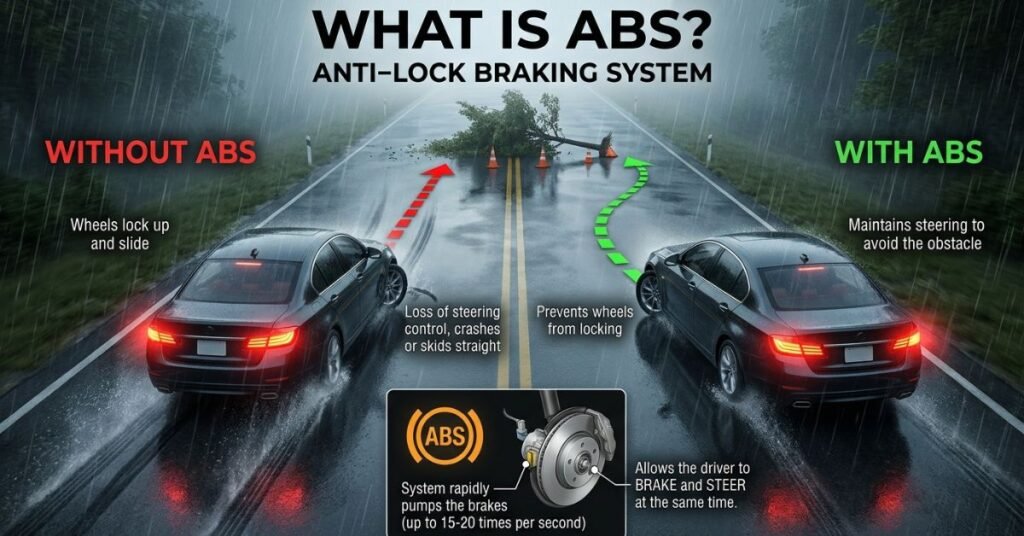
In the automotive industry, ABS stands for Anti-lock Braking System. It is a safety technology designed to help prevent a vehicle’s wheels from locking during hard braking.
When a wheel locks, it may lose much of its ability to maintain useful traction for steering. ABS monitors wheel movement and adjusts brake pressure when it detects that a wheel is about to lock. This process helps the driver maintain better directional control during many emergency-braking situations.
ABS is used in a wide range of vehicles, including passenger cars, motorcycles, commercial vehicles, and some other motorized transportation systems.
How Does an Anti-lock Braking System Work?
An ABS system typically includes wheel-speed sensors, an electronic control unit, and hydraulic components that regulate brake pressure.
The system works through a sequence of actions.
Step 1: Monitoring wheel speed
Sensors measure how quickly each wheel is rotating. The system continuously evaluates the signals to identify signs of excessive wheel deceleration.
Step 2: Detecting potential wheel lockup
During hard braking, a wheel may begin slowing down much faster than expected. The control unit identifies this condition and determines whether brake pressure needs to be adjusted.
Step 3: Regulating brake pressure
The ABS hydraulic control unit can reduce, maintain, or increase brake pressure as needed. This process helps prevent the wheel from remaining locked.
Step 4: Repeating the process
The system makes rapid adjustments while braking continues. Drivers may feel a pulsing sensation through the brake pedal in vehicles that use conventional pedal-feedback systems.
This pulsing is generally a normal part of ABS operation during an intervention. Drivers should follow the vehicle manufacturer’s guidance, which commonly advises maintaining firm, continuous pressure on the brake pedal during emergency braking in an ABS-equipped car.
Why Is ABS Important?
ABS can offer several important safety benefits.
Improved steering control
By helping prevent wheel lockup, ABS can allow drivers to retain more steering control while braking hard. This can be especially valuable when trying to steer around an obstacle.
Support during emergency braking
Unexpected hazards sometimes require sudden braking. ABS can help manage wheel behavior during these situations.
Reduced risk of uncontrolled skidding caused by locked wheels
A locked wheel may slide across the road surface. ABS is designed to help reduce this type of wheel lockup, although it cannot eliminate every form of skidding or loss of traction.
Additional support on changing road surfaces
Road conditions can vary because of rain, gravel, snow, loose dirt, or other surface characteristics. ABS helps manage braking under many conditions, but its effectiveness and stopping-distance outcomes depend on the vehicle, tires, and surface.
Does ABS Always Reduce Stopping Distance?
No. Although ABS is an important safety feature, it does not guarantee a shorter stopping distance in every situation.
On many paved surfaces, ABS helps maintain control during hard braking. However, stopping distance can vary considerably depending on tire condition, road texture, vehicle speed, weather, and system design. On some loose surfaces, such as deep gravel or certain snow conditions, a vehicle with ABS may require more distance to stop than one with locked wheels.
The main benefit of ABS is helping prevent wheel lockup and preserving steering control, rather than guaranteeing the shortest possible stop under all conditions.
What Does the ABS Warning Light Mean?
Many vehicles have an ABS warning light on the dashboard. If this light remains illuminated after the normal startup check, it may indicate a fault in the anti-lock braking system.
Possible causes include a faulty wheel-speed sensor, damaged wiring, a problem with the ABS control module, or another system-related issue.
If the ABS warning light stays on, consult the vehicle’s owner’s manual and arrange for a qualified technician to inspect the system. Conventional braking may still function, but the anti-lock feature may not be available. If the red brake warning light also appears, braking performance changes, or the pedal feels abnormal, stop safely and seek professional assistance.
ABS in Motorcycles
ABS is also used in motorcycles to help prevent the wheels from locking during hard braking. Motorcycle ABS can be especially helpful because a locked wheel can cause a loss of stability.
However, motorcycle ABS does not remove the need for safe riding techniques. Riders should still maintain appropriate speed, leave sufficient following distance, use suitable tires, and adjust their riding to road conditions.
3. ABS Meaning in Plastic and Manufacturing
In manufacturing, ABS stands for Acrylonitrile Butadiene Styrene. It is a thermoplastic material widely used to produce products that need a useful combination of strength, toughness, impact resistance, and ease of processing.
ABS is popular because manufacturers can mold it into complex shapes and use it in a broad range of applications. Its properties can vary according to the formulation, manufacturing process, and grade selected.
What Makes ABS Plastic Useful?
ABS combines characteristics associated with three chemical components:
- Acrylonitrile contributes to chemical resistance, heat resistance, and rigidity.
- Butadiene contributes to toughness and impact resistance.
- Styrene contributes to processability, rigidity, and surface appearance.
The proportions and structure of these components influence the final material’s performance. Different ABS grades are designed for different applications, so not every ABS product has identical properties.
Common Uses of ABS Plastic
ABS is used in many industries because it can be shaped into practical, durable components.
Automotive components
ABS plastic is used in various vehicle interior and exterior parts, including selected trim pieces, housings, and other molded components.
Electronic products
Keyboards, computer housings, control panels, and some appliance components may use ABS because it can be molded into precise shapes.
Toys and building bricks
Some toys and construction bricks are made from ABS because the material can provide toughness, dimensional stability, and a smooth finish.
Household products
ABS can be found in selected appliance parts, storage products, tool housings, and other consumer goods.
Three-dimensional printing
ABS is used as a filament in some 3D printers. It can produce durable printed parts, although printing it may require careful temperature control and ventilation.
Advantages of ABS Plastic
ABS offers several practical advantages.
- It provides a useful balance of toughness and rigidity.
- It is relatively easy to process using suitable molding techniques.
- It can produce smooth surfaces and detailed shapes.
- It is available in grades with different performance characteristics.
- It is useful for a broad range of consumer and industrial products.
These properties make ABS a common choice when manufacturers need a versatile engineering plastic.
Disadvantages of ABS Plastic
Despite its advantages, ABS is not suitable for every application.
It can soften or deform at elevated temperatures, and its resistance to ultraviolet exposure depends on the particular grade and any protective additives. Some solvents can also damage it. In addition, ABS is not biodegradable under ordinary environmental conditions.
For products exposed to sunlight, chemicals, high temperatures, or demanding outdoor conditions, manufacturers must evaluate whether ABS is the right material.
Is ABS Plastic Recyclable?
ABS can be recycled through suitable systems, but actual recycling depends on collection facilities, product design, contamination, and local processing capabilities.
Products made from different plastics may require separation before recycling. Consumers should follow local recycling guidance rather than assuming that every ABS item can be placed in a standard household recycling bin.
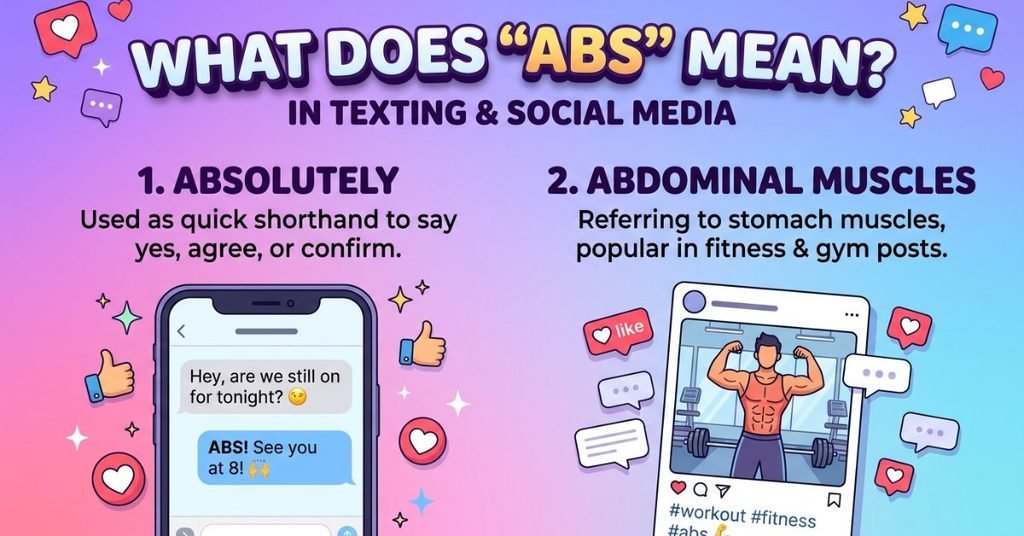
The abbreviation ABS may also appear in text messages, online discussions, captions, and social media posts. In these situations, its meaning is determined largely by the topic and the way the person uses it.
For example, a person discussing fitness may write, “I am working on my abs.” Someone discussing a vehicle might ask, “Does this model come with ABS?” A conversation about product design could mention ABS plastic.
Because abbreviations can be informal and community-specific, ABS does not have one universally accepted meaning in every text message or online conversation.
Examples of ABS in Everyday Communication
Fitness conversation
Person A: “What exercises do you do for your abs?”
Person B: “I usually do planks, dead bugs, and crunches.”
Here, abs refers to abdominal muscles.
Automotive conversation
Person A: “Is ABS included in this car?”
Person B: “Yes, this version has an anti-lock braking system.”
Here, ABS refers to a vehicle safety feature.
Manufacturing conversation
Person A: “What material is this printed component made from?”
Person B: “It uses ABS filament.”
Here, ABS refers to Acrylonitrile Butadiene Styrene.
These examples show why understanding the subject of a conversation is often more useful than relying on capitalization alone.
5. ABS Meaning in Business and Other Technical Fields
Outside fitness, automotive technology, and plastics, ABS can have specialized meanings in particular organizations and industries. These meanings may be used in accounting, education, engineering, shipping, finance, and administrative systems.
For instance, an organization may use ABS as an internal abbreviation for a department, process, document, or technical concept. The abbreviation may have a specific meaning within that organization without being widely understood elsewhere.
In finance, ABS can also refer to asset-backed securities. These are financial securities whose payments are supported by a pool of underlying assets, such as certain loans or receivables. Their structure and risks depend on the assets involved and how the securities are arranged.
This financial meaning is different from the meanings used in fitness, automobiles, and manufacturing.
When ABS appears in a report, contract, technical manual, or financial document, it is best to check the glossary or the first place where the abbreviation is defined. This avoids confusing one technical meaning with another.
6. How to Identify the Correct Meaning of ABS
If you encounter ABS and are unsure what it means, you can usually identify the intended definition by considering the surrounding information.
Look at the Subject
The subject provides the strongest clue. If the discussion concerns workouts, abdominal muscles are a likely meaning. If it concerns braking or vehicle safety, the term probably refers to the Anti-lock Braking System.
If the conversation is about polymers, molding, or 3D printing, ABS likely refers to the plastic material.
Check the Surrounding Words
Words such as “six-pack,” “core,” and “crunches” point toward fitness. Words such as “brakes,” “wheel speed,” and “dashboard” point toward automotive technology. Words such as “filament,” “thermoplastic,” and “molding” point toward manufacturing.
Consider Where You Saw It
A fitness website, vehicle manual, engineering specification, or financial report will usually provide clues about the relevant definition.
Check Whether the Abbreviation Is Defined
In formal writing, technical documents often define an abbreviation when it first appears. If a document does not explain the abbreviation, look for a glossary or ask the author for clarification.
Avoid Assuming That Capitalization Determines Meaning
People often use uppercase and lowercase letters inconsistently in informal writing. Although capitalization can provide a clue, the subject and surrounding words are more reliable indicators.
7. ABS vs. Abdominal Muscles: Are They the Same?
In ordinary fitness conversations, “abs” and “abdominal muscles” refer to the same general anatomical region. However, “ABS” is also an established abbreviation for several unrelated technical terms.
The distinction becomes clearer when the words are used in complete sentences.
- “She trains her abs twice a week” refers to exercise.
- “The vehicle’s ABS warning light is on” refers to automotive technology.
- “The enclosure is made from ABS” refers to a plastic material.
The spelling is similar, but the intended meaning changes with the context.
Also Read! HTN Meaning: What Does HTN Stand for in Medical Terms?
8. Why Is Understanding ABS Meaning Important?
Knowing the meaning of ABS can help people communicate more accurately and understand information in different settings.
For fitness beginners: Understanding the term helps them follow workout instructions, exercise plans, and discussions about core strength.
For car owners: Knowing what ABS means makes it easier to understand vehicle specifications, dashboard warnings, and basic safety information.
For students and designers: Understanding ABS plastic can help them learn about materials, product manufacturing, and 3D printing.
For readers and online users: Recognizing context-specific abbreviations reduces confusion when reading posts, articles, technical documents, and messages.
The broader lesson is that abbreviations should be interpreted in context rather than assumed to have a single universal definition.
Frequently Asked Questions About ABS Meaning
1. What does ABS stand for?
ABS has several meanings. The most common include abdominal muscles in fitness, Anti-lock Braking System in vehicles, and Acrylonitrile Butadiene Styrene in manufacturing. It can also mean asset-backed securities in finance.
2. What does ABS mean in simple words?
In simple terms, ABS can mean stomach muscles, a vehicle braking safety system, or a type of plastic. The subject of the conversation determines which meaning is correct.
3. What does ABS mean in a car?
ABS means Anti-lock Braking System. It helps prevent the wheels from locking during hard braking, which can help the driver maintain steering control.
4. What does ABS mean in fitness?
In fitness, abs refers to abdominal muscles. These muscles help stabilize the torso, support posture, and control certain body movements.
5. What does ABS mean in bodybuilding?
In bodybuilding, ABS usually refers to the abdominal muscles, especially when discussing their development and visible definition.
6. What does six-pack abs mean?
Six-pack abs refers to visible segments of the rectus abdominis muscle. Their appearance depends on muscle structure, body-fat distribution, genetics, and other factors.
7. What does ABS mean in plastic?
ABS stands for Acrylonitrile Butadiene Styrene, a thermoplastic used in many consumer products, electronic housings, automotive components, toys, and 3D printing.
8. Is ABS plastic strong?
ABS generally offers a useful balance of strength, toughness, and impact resistance. However, its performance depends on the specific grade and the conditions in which it is used.
9. Is ABS important for car safety?
Yes. ABS is an important safety feature because it helps prevent wheel lockup during hard braking and can help drivers maintain steering control. However, it does not eliminate every risk or guarantee a shorter stopping distance in every situation.
10. Can ABS mean something in finance?
Yes. In finance, ABS can stand for asset-backed securities. These are securities supported by payments from a pool of underlying assets.
11. Does ABS have the same meaning in texting?
Not necessarily. In texting, ABS may refer to abdominal muscles or a technical term discussed in the conversation. Its meaning depends on the surrounding message and community.
12. How can I know which ABS meaning is correct?
Look at the subject, surrounding words, and source. Exercise-related content usually points to abdominal muscles, vehicle-related content points to Anti-lock Braking System, and manufacturing content often points to ABS plastic.
Conclusion
The meaning of ABS depends on the context in which the abbreviation is used. In fitness, abs refers to abdominal muscles that help stabilize and move the body. In automotive technology, ABS stands for Anti-lock Braking System, which helps prevent wheel lockup during hard braking. In manufacturing, ABS means Acrylonitrile Butadiene Styrene, a versatile thermoplastic used in a wide range of products. In finance, it can also refer to asset-backed securities.
Although these meanings are different, identifying the correct one is usually straightforward when you consider the surrounding topic. Whether you are reading a fitness guide, checking vehicle specifications, learning about plastics, or studying financial terminology, understanding ABS can help you interpret information more accurately.
Ultimately, ABS is a useful example of how a single abbreviation can have several meanings across everyday life, science, technology, and business. By paying attention to context, you can understand the term and use it correctly.




[…] Also Read! ABS Meaning: What Does ABS Stand For? A Complete Guide […]