
PPM is a term commonly used in science, water testing, environmental monitoring, chemistry, agriculture, and manufacturing. Although it may look like a complicated technical abbreviation, its meaning is relatively simple. PPM stands for parts per million, a way of expressing how much of one substance exists within a larger mixture.
People encounter PPM when checking water quality, measuring dissolved minerals, examining air pollution, testing chemical solutions, or evaluating the purity of industrial materials. It is particularly useful when the quantity being measured is so small that expressing it as an ordinary percentage would produce a long decimal number.
Understanding PPM helps make technical measurements easier to read, compare, and interpret. However, the meaning of a PPM reading can change depending on what is being measured and how the result is reported.
In this guide, you will learn what PPM means, how it works, how to calculate and convert it, where it is used, and how to understand its practical significance.
What Does PPM Stand For?
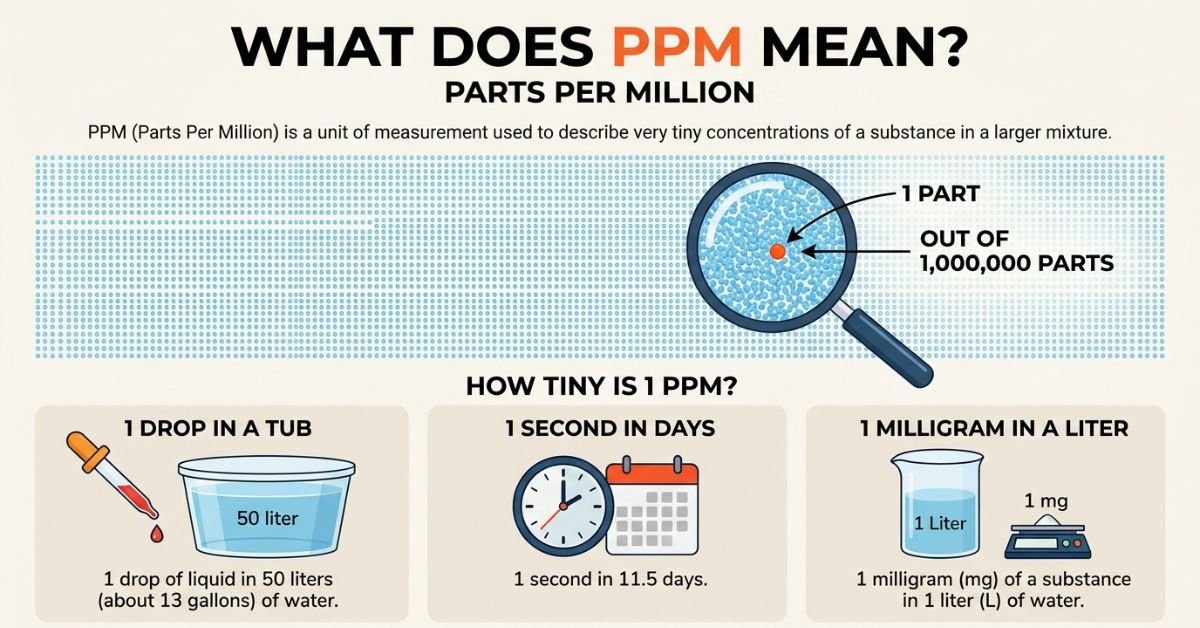
PPM stands for parts per million. It represents the proportion of a particular substance within one million parts of a mixture.
To understand this concept, imagine dividing a sample into one million equal portions. If one portion represents the substance you are measuring, its concentration is one PPM. If 100 portions represent that substance, the concentration is 100 PPM.
For example, if a material contains 20 PPM of an impurity by mass, it contains 20 parts of that impurity for every one million parts of the complete material by mass.
PPM is not limited to chemicals or liquids. It can also describe gas concentrations, trace elements, manufacturing defects, and certain types of technical deviations. The general idea remains the same: a relatively small quantity is compared with a larger reference quantity.
Because PPM uses a denominator of one million, it is particularly convenient for communicating small concentrations without writing extremely small decimal fractions.
What Is the Basic Meaning of PPM?
The simplest way to understand PPM is to think of it as a ratio.
A mixture may contain a main component and several smaller components. The component being measured could be a mineral dissolved in water, an unwanted element in metal, or a gas present in the air.
PPM tells you how much of the selected component exists relative to the total mixture.
For instance, consider a sample containing a very small amount of dissolved material. Instead of describing its concentration as a long decimal percentage, a laboratory can report the result as 15 PPM.
This means the substance accounts for 15 parts out of every one million parts of the sample on the specified measurement basis.
It is important to remember that PPM describes a proportion rather than a fixed amount. A PPM value does not tell you the total mass or volume of a sample unless you also know the sample size and measurement basis.
How Does PPM Work?
PPM works by comparing the quantity of a substance with the total quantity of the mixture and multiplying the resulting fraction by one million.
The general formula is:
PPM = (Amount of substance ÷ Total amount of mixture) × 1,000,000
The two quantities must be expressed in compatible units and measured on the same basis.
Suppose a batch of material weighs 500,000 grams and contains 5 grams of a particular impurity.
Using the formula:
PPM = (5 ÷ 500,000) × 1,000,000
Result: 10 PPM by mass.
This means that the impurity makes up 10 parts per million of the material by mass.
The same method can be applied to other mixtures, provided the relevant quantities are measured consistently. For gases, for example, a volume-based ratio may be used instead of a mass-based ratio.
What Is 1 PPM?
One PPM represents one part of a substance for every one million parts of the mixture.
As a decimal fraction, it is:
1 PPM = 0.000001
As a percentage, it is:
1 PPM = 0.0001%
For a mass-based measurement, one PPM is equivalent to one milligram of a substance per kilogram of the total mixture.
This relationship can be useful when examining small amounts of contaminants, trace minerals, or other components.
For example, if a solid material contains 1 milligram of a particular element in 1 kilogram of material, its concentration is 1 PPM by mass.
For dilute water-based solutions, 1 PPM is often approximately equivalent to 1 milligram per liter. This approximation depends on the density of the solution and the measurement method.
PPM Formula Explained With Examples
Calculating PPM becomes straightforward when you know the quantity of the substance and the total quantity of the mixture.
Example 1: Calculating PPM in a Solid Material
Suppose a laboratory finds 6 milligrams of an impurity in 3 kilograms of a material.
First, convert the total material mass into milligrams.
3 kilograms = 3,000,000 milligrams.
Now apply the formula:
PPM = (6 ÷ 3,000,000) × 1,000,000
Answer: 2 PPM by mass.
This means the material contains two parts of the impurity per million parts of the material.
Example 2: Calculating PPM in a Chemical Mixture
Imagine that a mixture contains 12 grams of a selected substance in a total mass of 2,000,000 grams.
PPM = (12 ÷ 2,000,000) × 1,000,000
Answer: 6 PPM by mass.
The result shows that the selected substance accounts for six parts per million of the mixture.
Example 3: Understanding PPM in Water
Suppose a water sample has a measured concentration of 80 milligrams per liter of a particular dissolved substance.
For a dilute aqueous solution with a density close to that of pure water, this concentration is approximately 80 PPM by mass.
The approximation is commonly used in water testing, but the exact relationship depends on the solution’s density and the way the concentration is defined.
These examples demonstrate that the main challenge in PPM calculations is usually choosing the correct quantities and converting units consistently.
PPM to Percentage Conversion
PPM and percentages both express proportions, but they use different reference scales.
A percentage represents a quantity per 100 parts, while PPM represents a quantity per one million parts.
To convert PPM into a percentage, divide the PPM value by 10,000.
Percentage = PPM ÷ 10,000
To convert a percentage into PPM, multiply the percentage value by 10,000.
PPM = Percentage × 10,000
For example, 350 PPM is equivalent to 0.035%, while 0.08% is equivalent to 800 PPM.
The following table provides a quick reference.
| PPM | Percentage |
|---|---|
| 1 PPM | 0.0001% |
| 10 PPM | 0.001% |
| 25 PPM | 0.0025% |
| 50 PPM | 0.005% |
| 100 PPM | 0.01% |
| 250 PPM | 0.025% |
| 500 PPM | 0.05% |
| 1,000 PPM | 0.1% |
| 5,000 PPM | 0.5% |
| 10,000 PPM | 1% |
| 100,000 PPM | 10% |
| 1,000,000 PPM | 100% |
This conversion is useful when a laboratory report, product specification, or technical document expresses concentration in a different format.
PPM vs. PPB vs. PPT
PPM is one of several units used to describe very small proportions. Other common abbreviations include PPB and PPT.
- PPM: Parts per million, or one part in 1,000,000.
- PPB: Parts per billion, or one part in 1,000,000,000.
- PPT: Parts per trillion, or one part in 1,000,000,000,000.
Here, billion and trillion follow the modern English short-scale convention.
These units allow scientists and engineers to express concentrations at different levels.
For example, a concentration of 1 PPM is equivalent to 1,000 PPB or 1,000,000 PPT. If the concentration of a substance is extremely small, PPB or PPT may provide a more convenient way to report the result.
The appropriate unit depends on the concentration range, the substance being measured, and the precision of the analytical method.
Also Read! OPP Meaning in Slang: What Does “Opp” Mean?
Is PPM the Same as mg/L?
PPM and mg/L are related, but they are not universally interchangeable.
PPM describes a proportion, while milligrams per liter expresses the mass of a substance in a specific volume of solution.
For dilute water-based solutions, 1 PPM by mass is often approximately equal to 1 mg/L because the density of water is close to 1 kilogram per liter.
For example, a water sample containing approximately 25 mg/L of a dissolved substance may be described as having a concentration of roughly 25 PPM.
However, the equivalence becomes less exact when density differs significantly from that of water or when the solution is concentrated. It is also important to distinguish a direct chemical measurement from an instrument estimate.
When accuracy matters, check the concentration basis, density, and reporting conventions rather than assuming the two units are identical.
What Does PPM Mean in Water?
Water testing is one of the most familiar applications of PPM. Water may contain naturally occurring minerals, dissolved salts, treatment chemicals, and contaminants at different concentrations.
PPM provides a convenient way to describe the quantity of a particular substance present in a water sample.
For example, laboratories may report concentrations of certain dissolved substances in PPM or in mg/L. Some portable instruments also display PPM estimates based on electrical conductivity.
These estimates are often used when assessing the total dissolved solids, or TDS, of water. TDS refers to the combined amount of dissolved substances, not a single chemical.
A TDS meter generally estimates the concentration from electrical conductivity using a conversion factor. Different dissolved substances conduct electricity differently, so two water samples with the same actual dissolved mass may produce different conductivity readings.
A PPM reading alone cannot establish whether water is safe to drink. Proper assessment may require testing for specific microorganisms, chemicals, metals, and other substances, followed by comparison with appropriate drinking-water standards.
What Does PPM Mean in Air Quality?
In air quality monitoring, PPM commonly describes the concentration of a gas within a mixture of gases.
For example, a gas detector may display the concentration of carbon monoxide or another gas in PPM by volume. A reading of 30 PPM by volume generally means that 30 volume units of the selected gas are present for every one million volume units of the mixture, under the applicable measurement convention.
Air monitoring equipment uses these measurements to help identify changes in gas concentrations and assess workplace or environmental conditions.
The meaning of a particular reading depends on the gas, the duration of exposure, the instrument’s accuracy, and the relevant safety requirements.
A low PPM value does not automatically mean that a gas is harmless. Some substances can be hazardous at low concentrations, which makes correct identification and interpretation essential.
What Does PPM Mean in Chemistry?
Chemists use PPM to describe trace concentrations in solutions, chemical mixtures, and solid materials.
It is especially useful when measuring substances that are present in quantities too small to express conveniently as percentages.
For example, a laboratory may use PPM to report trace elements in a metal sample, impurities in a chemical product, or a particular compound in a solution.
Mass-based PPM is calculated by dividing the mass of the selected component by the total mass of the mixture and multiplying by one million.
Chemistry reports should specify the measurement basis whenever necessary. A mass-based concentration and a volume-based concentration may have the same numerical value but represent different proportions.
The choice of analytical method also matters because each technique has its own detection limits, potential interferences, and uncertainty.
What Does PPM Mean in Agriculture and Gardening?
In agriculture, gardening, and hydroponics, PPM is often used to describe nutrient solutions and dissolved substances in irrigation water.
Growers may monitor a solution’s estimated concentration to maintain consistency and avoid applying too much or too little fertilizer.
However, a PPM reading from an electrical conductivity meter does not reveal the exact quantities of individual nutrients. A solution containing one mixture of minerals may produce a similar reading to another solution with a different composition.
Plant requirements also vary according to the crop, growth stage, growing medium, water source, and environmental conditions.
For that reason, PPM should be interpreted alongside other information, including nutrient composition, pH, electrical conductivity, and crop-specific recommendations.
What Does PPM Mean in Food and Beverage Testing?
Food laboratories may use PPM to report trace concentrations of selected substances in food products, ingredients, and beverages.
These substances can include minerals, chemical residues, contaminants, or certain ingredients used during processing.
For example, a laboratory may report a trace element in a food sample as milligrams per kilogram. For a mass-based measurement, one milligram per kilogram equals one PPM.
The importance of a particular reading depends on the substance, the product being tested, the amount consumed, and the applicable food safety requirements.
Detecting a substance does not automatically establish that a food is unsafe. Risk assessment may require information about exposure, toxicity, and regulatory limits.
PPM helps communicate the measured concentration, but it does not independently determine whether the product meets every safety requirement.
What Does PPM Mean in Manufacturing and Quality Control?
Manufacturers use PPM to describe trace impurities, material composition, production defects, and certain technical tolerances.
In electronics, a small amount of contamination can affect a component’s performance. In metal production, PPM may describe the concentration of a particular element. In food or chemical manufacturing, it can help track whether a material meets a defined specification.
Quality control teams also use a related measure called defects per million opportunities or, more generally, defects per million units.
For example, if 25 defective units are found among one million inspected units, the observed defect rate is 25 defects per million units, assuming each unit is counted once and the denominator is defined accordingly.
This is a count-based quality metric, not the same thing as a chemical concentration. Understanding the context prevents confusion when PPM appears in different industrial reports.
What Does PPM Mean in Electronics and Technology?
PPM can have specialized meanings in electronics and technical specifications.
For example, a component’s frequency accuracy or timing stability may be expressed in PPM relative to a reference value. In this context, the number describes a proportional deviation rather than the concentration of a substance.
A deviation of 10 PPM corresponds to a ratio of 10 in one million, or 0.001%.
For a reference frequency of 1,000,000 hertz, a deviation of 10 PPM corresponds to 10 hertz.
This kind of specification can help engineers evaluate oscillators, clocks, measurement devices, and other systems where small deviations matter.
Because the application differs from chemical testing, it is important to read the technical definition accompanying the value.
PPM by Weight vs. PPM by Volume
PPM can be reported using different measurement bases. Two common examples are parts per million by weight and parts per million by volume.
PPM by weight (ppmw) compares the mass of a substance with the total mass of a mixture.
For example, 4 milligrams of a substance in 4 kilograms of a mixture equals 1 PPM by mass.
PPM by volume (ppmv) compares the volume of one component with the total volume of the mixture. It is commonly used for gases.
These two forms of PPM are not automatically interchangeable. Converting between them may require information about molecular weight, density, temperature, pressure, and the physical state of the material.
For reliable comparisons, always check how the PPM value was defined and reported.
How Is PPM Measured?
There is no single instrument that measures every type of PPM value. The correct method depends on the sample and the substance being examined.
Water laboratories may use chemical analysis, spectrophotometry, ion-selective electrodes, or other methods to measure particular dissolved substances.
Air monitoring equipment may measure selected gases directly and display their concentrations in PPM.
Industrial laboratories may use techniques such as atomic absorption spectroscopy or inductively coupled plasma analysis to determine trace element concentrations.
Portable meters can provide quick estimates for specific applications, but their results may depend on calibration, the conversion method used, and the composition of the sample.
When evaluating a measurement, consider the instrument’s detection limit, uncertainty, calibration status, and suitability for the substance being tested.
Also Read! Hamsa Meaning: Symbolism, Spiritual Significance, History, and the Power of the Hand of Protection
PPM Conversion Chart: Quick Reference
The following chart summarizes several useful relationships between PPM, mass-based concentrations, and percentages.
| Measurement | Equivalent value |
|---|---|
| 1 PPM by mass | 1 mg/kg |
| 10 PPM by mass | 10 mg/kg |
| 100 PPM by mass | 100 mg/kg |
| 1,000 PPM by mass | 1 g/kg |
| 10,000 PPM by mass | 1% by mass |
| 1 PPM as a fraction | 0.000001 |
| 1 PPM as a percentage | 0.0001% |
| 1% | 10,000 PPM |
| 1,000 PPB | 1 PPM |
| 1,000,000 PPT | 1 PPM |
These relationships assume consistent definitions and measurement bases. The mass-based conversions do not mean that every PPM reading is automatically equivalent to the same value in mg/L.
Is a Higher PPM Value Always Bad?
A higher PPM value is not necessarily harmful, and a lower value is not always better.
The interpretation depends on the substance being measured and its purpose within the mixture. Some components are useful or necessary at particular concentrations, while others may need to remain below strict limits.
For example, a dissolved mineral may be desirable in one application but unsuitable at a different concentration. A contaminant may also have a concentration limit that depends on the product, exposure route, and applicable regulations.
The correct way to evaluate a PPM result is to identify the substance, understand the measurement method, and compare the result with an appropriate technical or regulatory reference.
The number alone is not enough to determine safety, quality, or suitability.
Factors That Can Affect PPM Readings
The reliability of a PPM result depends on more than the formula used to calculate it. Several practical factors can influence the measurement.
Sample preparation: Poor mixing, contamination, or incorrect storage may change the sample before testing.
Instrument calibration: An improperly calibrated instrument can produce readings that differ from the true concentration.
Measurement method: Different analytical techniques have different levels of sensitivity, uncertainty, and susceptibility to interference.
Temperature and density: These factors can affect certain conversions, particularly when comparing mass-based and volume-based measurements.
Sample composition: Other substances may interfere with a test or affect an indirect instrument reading.
Reporting basis: Results reported by mass, volume, or estimated dissolved-solids concentration should not be compared without checking their definitions.
Following suitable testing procedures and reporting the measurement basis makes PPM results easier to interpret and compare.
Common Mistakes When Understanding PPM
Although the concept of PPM is simple, several common mistakes can lead to incorrect conclusions.
Confusing PPM With Percentage
One PPM equals 0.0001%, not 1%. A percentage represents a much larger proportion than the same numerical value expressed in PPM.
Using Incompatible Units
The amount of the substance and the total mixture must be expressed in compatible units. Comparing milligrams directly with kilograms without converting them first can produce an incorrect calculation.
Assuming PPM and mg/L Are Always Identical
This approximation is often useful for dilute water-based solutions, but it is not a universal conversion.
Treating All PPM Measurements as the Same
Chemical concentration, gas volume fraction, defect rates, and technical deviations can all use PPM terminology. Their interpretation depends on the application.
Judging Safety From One Number
A PPM reading does not automatically indicate whether a product, water sample, or air environment is safe. The substance and relevant standards must also be considered.
Avoiding these errors helps make concentration measurements more meaningful.
Frequently Asked Questions About PPM
1. What is the full form of PPM?
PPM stands for parts per million. It is used to describe the proportion of a substance within a larger quantity.
2. What does PPM mean in simple words?
In simple terms, PPM tells you how many parts of a particular substance are present in one million parts of a mixture.
3. How much is 1 PPM?
One PPM equals a fraction of 0.000001, or 0.0001%. For a mass-based concentration, it is equivalent to 1 milligram per kilogram.
4. How many PPM are in 1%?
One percent equals 10,000 PPM. To convert a percentage into PPM, multiply the percentage value by 10,000.
5. What does 100 PPM mean?
A concentration of 100 PPM means 100 parts of the selected substance per million parts of the mixture on the specified measurement basis. By mass, this equals 100 milligrams per kilogram.
6. What does 500 PPM mean in water?
A reading of 500 PPM may represent an estimated dissolved-solids concentration or the concentration of a particular substance, depending on the instrument and test. It does not, by itself, establish whether the water is safe to drink.
7. Is PPM a unit of measurement?
PPM is a dimensionless ratio expressed relative to one million parts. It is commonly treated as a concentration unit, although its exact interpretation depends on the quantity being compared.
8. What is the difference between PPM and PPB?
PPM means parts per million, while PPB means parts per billion. One PPM equals 1,000 PPB.
9. Can PPM be used for solids, liquids, and gases?
Yes. PPM can describe proportions in solid materials, liquid mixtures, and gases. The measurement basis may differ depending on the sample and application.
10. Why is PPM important?
PPM helps people measure, report, and compare small concentrations. It is useful in laboratory analysis, environmental monitoring, water treatment, manufacturing, agriculture, and technical quality control.
11. Does a low PPM value mean a substance is safe?
Not necessarily. Safety depends on the identity of the substance, its concentration, exposure conditions, and the relevant safety standards.
12. How do you convert PPM to a decimal?
Divide the PPM value by 1,000,000. For example, 25 PPM equals a decimal fraction of 0.000025.
Conclusion
PPM, or parts per million, is a practical way to describe very small proportions of a substance within a larger mixture. It makes concentration values easier to communicate when percentages or ordinary measurements are less convenient.
From water quality testing and air monitoring to agriculture, chemical analysis, electronics, and manufacturing, PPM provides a common way to express small quantities and compare results.
Understanding the relationship between PPM, percentages, PPB, PPT, and concentration units makes it easier to interpret technical reports and calculations. Just as importantly, knowing the measurement basis helps prevent incorrect comparisons.
Whenever you encounter a PPM value, identify what is being measured, check how the result was obtained, and compare it with the appropriate reference standard. With this approach, PPM becomes a clear and useful tool rather than a confusing technical abbreviation.




[…] Also Read! PPM Meaning: What Does Parts Per Million (PPM) Mean? […]