Introduction
Understanding the strengths and weaknesses of a business, identifying new opportunities, and preparing for possible challenges are essential parts of making informed decisions. Whether you are a student, entrepreneur, business owner, or professional, having a clear understanding of your current situation can help you plan more effectively. This is where SWOT analysis becomes useful. It is a simple yet practical framework that helps individuals and organizations evaluate their position, recognize areas for improvement, and develop strategies for future growth. In this beginner’s guide, you will learn the meaning of SWOT, its four main components, its benefits, practical examples, and how to conduct an effective SWOT analysis.
What Is the Meaning of SWOT?
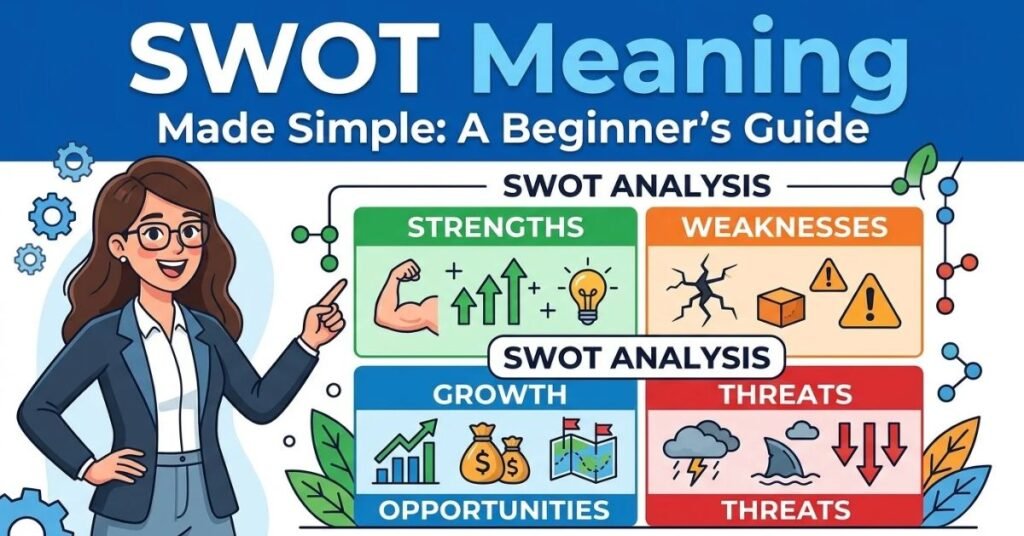
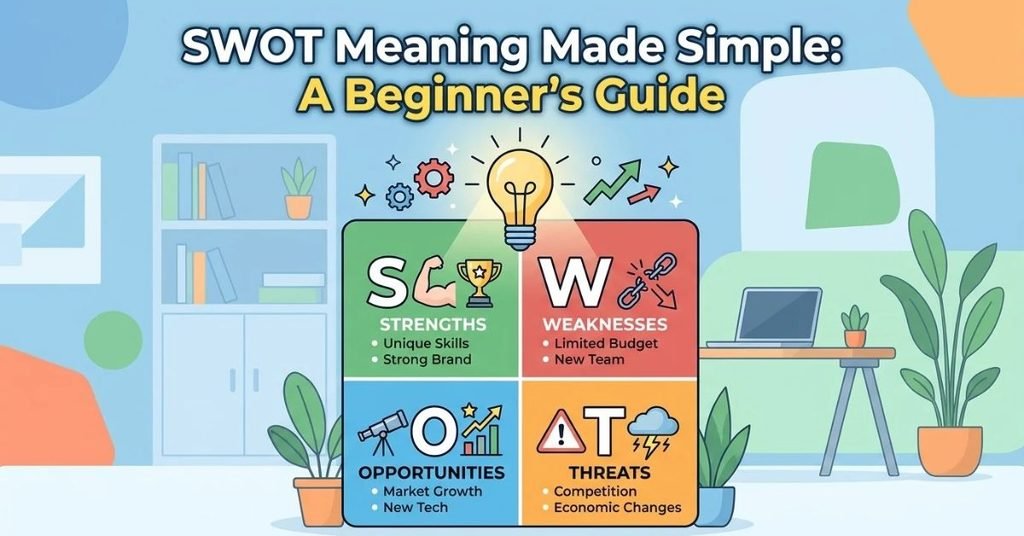
SWOT stands for Strengths, Weaknesses, Opportunities, and Threats. It is a strategic planning technique used to examine the internal and external factors that may affect a business, project, organization, or individual. The main purpose of SWOT analysis is to provide a clearer understanding of the current situation so that better decisions can be made. By examining what is working well, what needs improvement, what possibilities exist, and what challenges may arise, people can develop realistic plans and set meaningful priorities.
For example, a small online business may have high-quality products and loyal customers but limited advertising resources. At the same time, increasing demand for online shopping may create new growth opportunities, while stronger competition could present a challenge. A SWOT analysis helps the business owner understand these factors together and determine which actions deserve attention first.
What Does SWOT Stand For?
Each letter in SWOT represents an important category that helps evaluate a particular situation. Strengths and weaknesses relate to internal factors, while opportunities and threats relate to external conditions. Understanding this distinction makes it easier to organize information and identify useful strategies.
| SWOT Element | Meaning | Description | Example |
|---|---|---|---|
| Strengths | Internal advantages | Qualities, resources, or capabilities that support success | Skilled employees, loyal customers, or strong product quality |
| Weaknesses | Internal limitations | Areas that reduce performance or make goals harder to achieve | Limited funding, outdated equipment, or poor time management |
| Opportunities | Favorable external conditions | Outside developments that may create possibilities for growth | Emerging markets, new technologies, or increasing customer demand |
| Threats | External risks | Outside conditions that could negatively affect performance | New competitors, rising costs, or changing regulations |
The main difference between these categories is that internal factors usually can be influenced directly, whereas external factors generally require adaptation rather than complete control. For instance, a company can train its employees to improve productivity, but it cannot independently control changes in the overall economy.
Understanding the Four Components of SWOT Analysis
Strengths
Strengths are the internal qualities and resources that provide an advantage. They explain what a business or individual does well and which capabilities can support the achievement of goals. Common strengths include experienced employees, a positive reputation, effective management, reliable customer service, specialized knowledge, and efficient business processes. Identifying these advantages helps people understand which resources should be protected and used more effectively.
For example, a local bakery may have a loyal customer base, fresh ingredients, and popular homemade recipes. These strengths can help the bakery attract repeat customers and differentiate itself from competing businesses. Recognizing such advantages allows the owner to build strategies around what already works well.
Weaknesses
Weaknesses are internal limitations that can prevent an individual or organization from achieving its objectives efficiently. These may include a shortage of financial resources, insufficient training, outdated technology, poor communication, limited marketing experience, or inefficient procedures. Identifying weaknesses is important because it helps reveal areas that require attention, investment, or improvement.
For instance, a small clothing store may offer attractive products but struggle to maintain accurate inventory records. This problem could lead to stock shortages, delayed orders, and dissatisfied customers. By recognizing the weakness, the owner can introduce better inventory management practices and improve overall performance.
Opportunities
Opportunities are favorable external conditions that may help a business or individual grow, improve performance, or reach new goals. They can arise from changing customer preferences, technological developments, market gaps, partnerships, or new industry trends. Identifying opportunities helps people explore possibilities that match their existing strengths and available resources.
For example, a small business that sells handmade products may discover that customers increasingly prefer personalized gifts. This trend could create an opportunity to introduce customized products and reach new customers through online platforms. However, an opportunity is not a guaranteed success; it must be evaluated carefully before resources are committed.
Threats
Threats are external conditions that may create obstacles or negatively affect performance. These can include rising production costs, new competitors, economic uncertainty, changing customer behavior, supply chain disruptions, or new regulations. Although threats cannot always be prevented, identifying them early allows individuals and businesses to prepare suitable responses.
For example, a restaurant may face rising ingredient prices and increased competition from nearby food outlets. The owner could respond by reviewing supplier agreements, reducing unnecessary waste, improving customer loyalty, and adjusting menu prices carefully. This approach helps the business prepare for challenges rather than reacting only after problems become serious.
Why Is SWOT Analysis Important?
SWOT analysis is important because it organizes information into a clear structure that supports decision-making and strategic planning. Instead of focusing only on positive developments or existing problems, it encourages a balanced assessment of the situation. Businesses can use the findings to evaluate expansion plans, improve products, allocate resources, understand competition, and identify areas that require attention. Individuals can also apply the framework to educational goals, career planning, and personal development.
Another important benefit is that SWOT analysis encourages preparation. Recognizing external opportunities can help people explore growth, while understanding threats can encourage them to consider risks before making major commitments. When the findings are supported by reliable information and connected to practical actions, the analysis becomes a useful foundation for setting priorities and improving results.
| Benefit | Explanation | Practical Example |
|---|---|---|
| Better decision-making | Provides a structured view of important factors | Evaluating whether to launch a new product |
| Improved planning | Helps establish priorities and realistic objectives | Creating a marketing plan based on available resources |
| Identification of weaknesses | Reveals areas that need improvement | Providing additional employee training |
| Opportunity recognition | Highlights favorable external developments | Expanding into an underserved customer market |
| Risk awareness | Helps identify potential challenges early | Preparing for rising supplier costs |
| Resource management | Encourages effective use of available capabilities | Investing in the business activities with the greatest potential |
How to Conduct a SWOT Analysis Step by Step
Conducting a SWOT analysis does not require specialized software or advanced business knowledge. You can begin with a notebook, spreadsheet, or simple four-section table. The most important part is to define a clear objective, gather relevant information, evaluate each category honestly, and use the findings to develop an action plan.
| Step | Action | What to Consider |
|---|---|---|
| 1. Define the objective | Decide what you want to evaluate | A business, product, project, career, or personal goal |
| 2. Identify strengths | List internal advantages | Skills, resources, experience, reputation, and customer relationships |
| 3. Identify weaknesses | Examine internal limitations | Budget constraints, knowledge gaps, inefficient processes, or missing resources |
| 4. Explore opportunities | Research favorable external conditions | Market trends, customer needs, partnerships, and new technologies |
| 5. Assess threats | Identify external risks | Competitors, economic changes, rising costs, and regulatory developments |
| 6. Develop an action plan | Turn findings into practical steps | Priorities, responsibilities, deadlines, and measurable outcomes |
After completing these steps, review the information to determine which factors have the greatest potential impact. Avoid treating every item as equally important. A weakness that directly prevents a major goal may deserve immediate attention, while a minor issue can be addressed later. Similarly, an opportunity should be evaluated according to its feasibility, potential benefits, and resource requirements.
Practical Example of SWOT Analysis
Consider a fictional coffee shop called Morning Brew. The shop serves fresh coffee and snacks in a busy neighborhood and wants to increase sales while attracting more regular customers. Its owner decides to conduct a SWOT analysis to understand the business’s current position and identify possible improvements.
| Category | SWOT Analysis for Morning Brew |
|---|---|
| Strengths | Fresh coffee, friendly service, loyal customers, and a convenient location |
| Weaknesses | Limited advertising budget, small seating area, and no online ordering system |
| Opportunities | Office coffee packages, online preorders, seasonal drinks, and a customer loyalty program |
| Threats | New coffee shops, increasing ingredient costs, changing customer spending habits, and competitors offering discounts |
The analysis suggests that Morning Brew should build on its existing customer relationships while exploring opportunities to attract additional customers. For example, introducing office coffee packages could help the business reach customers beyond its usual morning visitors. A simple online preorder system might also improve convenience without requiring a major expansion of the physical shop.
At the same time, the owner should monitor ingredient prices and evaluate competitors’ offers. By connecting the four SWOT categories to specific decisions, the business can create a more focused plan for growth and prepare for potential challenges.
SWOT Analysis for Personal Development
SWOT analysis can also help individuals understand their capabilities, identify areas for improvement, and plan their next steps. Students may use it to improve academic performance, while professionals can apply it when considering a career change or developing new skills. The framework encourages honest self-assessment and helps people identify opportunities that match their existing abilities.
For example, a recent graduate who wants to work in digital marketing might have strong writing skills but limited experience with analytics software. Entry-level positions and online courses could provide opportunities, while competition for available jobs might represent a threat.
| Category | Personal Development Example |
|---|---|
| Strengths | Communication skills, creativity, and strong writing ability |
| Weaknesses | Limited professional experience and insufficient knowledge of analytics tools |
| Opportunities | Internships, professional courses, entry-level jobs, and portfolio projects |
| Threats | Competition for vacancies and rapidly changing digital marketing skills |
Based on this assessment, the graduate could develop a portfolio, complete practical projects, learn analytics tools, and apply for internships. This example demonstrates how SWOT analysis can turn general career ambitions into a clearer development plan.
Also Read! PPM Meaning: What Does Parts Per Million (PPM) Mean?
SWOT Analysis Compared With Other Planning Tools
SWOT analysis is often used alongside other planning frameworks. Each tool serves a different purpose, so understanding the differences helps you choose the most appropriate approach for a particular situation.
| Planning Tool | Main Purpose | Typical Use |
|---|---|---|
| SWOT Analysis | Evaluates strengths, weaknesses, opportunities, and threats | Understanding the current position of a business or project |
| PESTLE Analysis | Examines political, economic, social, technological, legal, and environmental factors | Studying the broader external environment |
| SMART Goals | Helps create specific, measurable, achievable, relevant, and time-bound objectives | Establishing clear targets and deadlines |
| Competitive Analysis | Examines competitors’ products, strategies, and market positions | Identifying competitive advantages and market gaps |
| Risk Assessment | Identifies and evaluates potential risks | Preparing for problems that could affect a project or organization |
These tools can complement one another. For example, a company may use PESTLE analysis to investigate changes in the external environment, SWOT analysis to evaluate how those changes affect its position, and SMART goals to define the actions needed to respond.
Common Mistakes to Avoid in SWOT Analysis
One common mistake is confusing internal factors with external conditions. For example, employee skills belong under strengths or weaknesses, while changing market demand generally belongs under opportunities or threats. Another mistake is using vague statements that do not explain the actual issue. Specific observations, supported by evidence where possible, provide a stronger foundation for decision-making.
It is also important to avoid listing too many factors without prioritizing them. A lengthy analysis may appear detailed but can become difficult to use if it does not identify the most important issues. Finally, completing the analysis without creating an action plan limits its value. SWOT analysis should lead to decisions, practical steps, and regular reviews rather than remaining a document that is never used.
| Common Mistake | Why It Is a Problem | How to Avoid It |
|---|---|---|
| Mixing internal and external factors | Makes the analysis less accurate | Determine whether each factor originates inside or outside the organization |
| Using vague statements | Makes it difficult to decide what action is needed | Write specific, clear, and relevant observations |
| Ignoring evidence | Can lead to unreliable conclusions | Use research, feedback, and performance information |
| Listing too many factors | Makes priorities harder to identify | Focus on the factors with the greatest impact |
| Ignoring potential threats | Leaves the business less prepared for challenges | Review market conditions and possible risks |
| Failing to take action | Prevents findings from producing practical value | Create an action plan with deadlines and measurable outcomes |
Advantages and Limitations of SWOT Analysis
SWOT analysis is popular because it is easy to understand, flexible, and inexpensive to conduct. It can be applied to businesses of different sizes, individual goals, academic projects, and organizational planning. It also encourages discussion and helps people consider positive and negative factors together instead of focusing on only one side of a situation.
However, SWOT analysis has limitations. Its quality depends on the accuracy of the information and the judgment of the people conducting it. The framework does not automatically rank factors by importance, guarantee that a particular strategy will succeed, or predict future events. Its findings can also become outdated when circumstances change. For these reasons, SWOT analysis should be combined with appropriate research, careful evaluation, and regular reviews.
| Advantages | Limitations |
|---|---|
| Easy for beginners to understand | Results can be subjective |
| Requires few resources to conduct | Does not automatically prioritize factors |
| Suitable for businesses and individuals | Cannot guarantee successful decisions |
| Helps identify opportunities and risks | May become outdated as conditions change |
| Supports planning and discussion | Requires additional research for deeper analysis |
Also Read! OPP Meaning in Slang: What Does “Opp” Mean?
Frequently Asked Questions About SWOT Meaning
What does SWOT stand for in simple words?
SWOT stands for Strengths, Weaknesses, Opportunities, and Threats. It is a framework for understanding what supports success, what limits progress, what favorable possibilities exist, and what external challenges may arise.
What is the main purpose of SWOT analysis?
The main purpose of SWOT analysis is to evaluate a current situation and support better decisions. It helps people understand their advantages, identify areas for improvement, recognize opportunities, and prepare for potential risks.
Who can use SWOT analysis?
Business owners, students, entrepreneurs, managers, project teams, nonprofit organizations, and individuals can all use SWOT analysis. It is useful whenever someone needs to evaluate a situation or plan for improvement.
Can SWOT analysis be used for personal goals?
Yes. Individuals can use SWOT analysis to evaluate their skills, career options, academic performance, and personal development needs. It helps identify useful next steps based on current abilities and available opportunities.
Is SWOT analysis suitable for small businesses?
Yes. Small businesses can use SWOT analysis to understand their resources, customer relationships, competition, and growth opportunities. It provides a practical starting point for planning without requiring expensive software or complicated procedures.
How often should a SWOT analysis be conducted?
The timing depends on the purpose of the analysis. It can be conducted when starting a project, launching a product, planning business expansion, or reviewing performance. It should also be revisited when significant changes affect the business or its environment.
Conclusion
SWOT meaning becomes easier to understand when the acronym is divided into its four components: Strengths, Weaknesses, Opportunities, and Threats. Together, these categories provide a structured way to examine internal capabilities and external conditions. The framework can help businesses improve their strategies, students plan their development, and professionals make more informed career decisions.
The real value of SWOT analysis lies in how its findings are used. By gathering reliable information, identifying the most important factors, and developing a practical action plan, you can turn a simple assessment into a useful decision-making tool. Although SWOT analysis cannot eliminate uncertainty or guarantee success, it can help you understand your current position and make more thoughtful plans for the future.