Decoding the internet’s most awkwardly blunt abbreviation: origins, etiquette, replies, and look-alikes
| Quick Answer DTF is shorthand for “down to f***.” Online, it signals that a person is open to casual sex, or asks whether the other person is. A handful of harmless spin-offs exist (down to fight, fish, or feast), and in the garment trade DTF means “Direct to Film,” a printing technique. When you meet the letters, let the sender, the platform, and the surrounding conversation tell you which one is meant. |
Key Takeaways
- The expression is casual internet slang built on the everyday phrase “down to,” meaning willing or up for something.
- Its default reading is sexual and blunt, so it lands badly with anyone who did not invite that kind of talk.
- Dating apps and private flirtatious chats use it literally; memes, comment sections, and friend groups often use it as a joke.
- Non-sexual versions exist, and “DTF printing” is a legitimate industry term for transferring designs to fabric.
- Your reply is your decision. A short, calm answer works for yes, maybe, or no, and unwanted senders can be blocked.
- When in doubt, say what you mean in plain, kind language instead of relying on three loaded letters.
Some abbreviations fade after a season. Others stick around because they do a job that nothing else does quite as bluntly. DTF belongs in the second group. It turns up in late-night direct messages, dating profiles, comment sections, and even printer catalogues, and each of those settings gives it a different flavor. If you have ever glanced at a screen and thought “wait, did they just ask what I think they asked?”, this guide is for you. Below, we unpack the phrase piece by piece: where the words come from, what each platform does with them, when they cross a line, how to answer, and what else the same letters can stand for.
DTF Meaning in Texting
Inside a text thread, DTF is a compressed way to raise the topic of casual sex. It saves the sender from typing an explicit phrase while still making the message unmistakable to anyone who knows the code. The letters can appear as a question aimed at you, a declaration about the sender, or a remark about someone else entirely.
What makes it tricky is that texting strips away tone of voice and facial expression. The exact same message can be a warm, mutual flirtation between two people who have been circling each other for weeks, or an intrusive opener from someone you have never met. Because of that, the history between the two people matters more than the letters themselves.
What Does DTF Stand For?
The accepted expansion is “down to f***.” Break it into two pieces. “Down to” is long-standing American slang for being game or available, the way someone might be “down to carpool” or “down to catch a movie.” The final word is a common profanity referring to sex, and the abbreviation exists largely to keep that word off the screen.
Grammatically, DTF is an initialism: you say each letter aloud (dee-tee-eff) rather than pronouncing it as a word. Over time people have also created tongue-in-cheek reinterpretations for the last letter. These variations are usually deliberate jokes or hobby-group inventions, and they tend to come with obvious clues such as a related emoji or topic. Without those clues, the sexual meaning is the safest guess.
How Is DTF Used in Conversations?
Think of DTF as a tool that gets used in a few recognizable ways.
- The invitation. One person floats the idea directly: “You DTF after the party?” It is short, forward, and expects a clear answer.
- The disclosure. Someone states their position to avoid confusion, either “I’m DTF if you are” or “just so you know, I’m not DTF.”
- The gossip. A third party is discussed: “Do you think he’s DTF?” This version speculates about another person’s wishes and can turn disrespectful fast.
- The joke. Friends sprinkle it into banter, memes, or captions with no genuine intent, often with exaggerated emoji.
Notice that only the first two involve a real, live question of consent. The gossip and joke forms are commentary, which is why it helps to work out which of the four you are looking at before you react.
Examples of DTF in Text Messages
Here are fresh, made-up snippets showing how the same three letters can tilt in different directions.
| Sample message | What is probably going on |
| “Coming over tonight? Fair warning, I’m DTF 😉” | A confident, mutual-flirt invitation between people who already know each other. |
| “Random question, are you DTF or do you actually want coffee?” | Someone trying to clear up mixed signals before a first meet-up. |
| “Matched with a guy who opened with ‘DTF?’ Hard pass.” | A complaint about an aggressive opener, common in venting posts. |
| “Not DTF. Just want someone to talk to tonight.” | A clear boundary paired with a request for company. |
| “Who’s DTF (down to fish) at sunrise??” | A hobby group repurposing the acronym for laughs. |
| “My cousin is starting a DTF shirt shop.” | Direct to Film printing, with zero connection to slang. |
Once the acronym leaves private messages and hits public feeds, its character shifts. In open spaces, people use it to get a reaction, to riff on a viral moment, or to poke fun at dating culture. Sarcasm is everywhere, so a post that contains DTF is not necessarily an invitation. It might be a joke about someone’s hectic week, a caption on a selfie, or a reference to a trending sound.
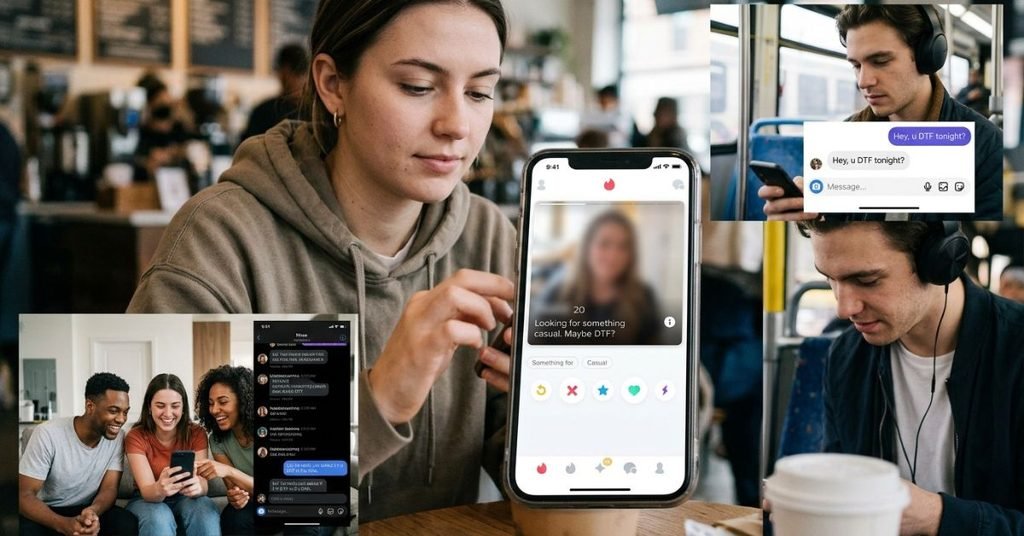
Still, platforms watch for sexual language. Repeatedly dropping the term into strangers’ comment sections can trigger warnings, hidden replies, or account restrictions. Creators who want the joke without the penalty often disguise it with spacing, symbols, or emoji.
DTF on Snapchat, Instagram, TikTok, and Dating Apps
- Snapchat: Its temporary-message design encourages looser, faster conversation, so DTF turns up mostly in one-to-one chats between people who already have some rapport.
- Instagram: Expect it in DMs, story replies, and memes. Cold messages containing it are one of the quickest routes to being blocked or reported.
- TikTok: It functions mainly as comedy, showing up in skits, stitched videos, and comment banter, frequently in a censored spelling to slip past filters.
- Dating apps: This is where the phrase is closest to literal. Some profiles announce it or reject it outright, while many users would rather see intentions spelled out in ordinary language than hinted at with initials.
Is DTF Considered Slang?
Definitely. DTF sits alongside FOMO, IYKYK, and BRB as a product of chat culture, where speed and shared understanding are prized. It has no place in dictionaries of formal English, business style guides, or academic writing. It is also generationally uneven: younger and very online people recognize it immediately, while others may misread it or miss it altogether. That gap is one more reason to think before dropping it into a conversation.
Is DTF a Positive, Negative, or Offensive Term?
The letters carry no built-in judgment. What matters is how, where, and to whom they are delivered. Picture a spectrum:
- Helpful: between two consenting adults who are attracted to each other, it can be a quick, honest way to check that both want the same thing.
- Awkward: among acquaintances or when the timing is off, it can make the other person feel put on the spot.
- Hurtful: used as a label to shame or stereotype someone, especially women, it turns into an insult about their character.
- Unacceptable: sent to someone who has not shown interest, to coworkers, or to minors, it moves into harassment territory.
So, is it offensive? Not in the way a slur is, but its sexual explicitness gives it plenty of potential to offend when the setting is wrong.
When Is It Appropriate to Use DTF?
Think of appropriate use as a checklist you complete before hitting send. It usually fits only when:
- Every person in the conversation is an adult.
- Attraction and interest have already been expressed by both sides.
- The exchange is private, not broadcast to a group or public comment thread.
- Declining would be easy and would not damage anything between you.
A second acceptable zone is bantering with friends who share your humor and know you would never mean it seriously, though even there it is polite to read the room.
Also Read! LFG Meaning: What It Really Stands For and How to Use It Like a Native
When Should You Avoid Using DTF?
Certain situations call for zero use of the term, no matter how casual you feel:
- Workplace chats, professional networks, and anything involving clients or supervisors.
- Conversations with relatives, teachers, or people from other generations who may find it inappropriate.
- First contact with someone you do not know.
- Group chats with mixed company, where a joke for one person could be an insult to another.
- Any exchange with someone under 18, which is inappropriate and potentially unlawful.
- Moments when the other person has already said no, gone quiet, or seemed uneasy.
If you are hesitating, that hesitation is your answer. Choose something clearer and kinder.
DTF Meaning Depending on Context
Four clues will help you decode almost any DTF sighting. First, who sent it: a partner, a friend, a stranger, or a business? Second, where it appeared: a dating app, a printing forum, a comment section, or a private chat? Third, what came right before it: was the vibe romantic, silly, or practical? Fourth, what words surround it: “fabric,” “transfer,” and “heat press” point to printing, while “fishing trip” or “brawl” suggest a joke. Weigh those clues together and the intended meaning usually becomes obvious. If it does not, you are entitled to ask a plain question like “What do you mean by that?”
DTF vs. Other Similar Slang Terms
| Term | Usual meaning | Key difference from DTF |
| Hookup | A brief, casual encounter | Refers to the event itself, while DTF expresses willingness for one. |
| FWB | Friends with benefits | An ongoing arrangement; DTF is a one-moment signal. |
| Netflix and chill | A hint-laden invitation to hang out | Coy and deniable, whereas DTF is unmistakably direct. |
| Talking stage | Early getting-to-know-you phase | Concerns the pace of a relationship, not sexual intent. |
| Thirsty | Eager for attention or romance | Describes a mood or behavior, not a question. |
| Down bad | Longing deeply for someone | About emotional yearning rather than casual invitation. |
How to Respond When Someone Says DTF
You control the outcome. Choose the reply that matches your real feelings, and remember that a pause is allowed too.
- You’re interested. Respond openly and set expectations: “I’m open to it. Let’s talk about what we each want first.” Clear communication makes any encounter safer and more enjoyable.
- You’re curious but hesitant. Slow it down: “I’d like to know you better before deciding.” It keeps things honest without shutting the door.
- You’re not interested. Keep it brief and firm: “That’s a no from me, thanks.” An explanation is optional.
- You suspect it’s a joke. Answer lightly and test the waters: “Depends what the F stands for 😄.”
- It feels unwelcome or aggressive. Stop replying, block the sender, and use the report button. You do not owe politeness to someone who ignores your comfort.
If the person keeps pushing after you decline, that persistence is information about them, not a reason to reconsider.
Common Misunderstandings About DTF
- Myth: it is a harmless, meaningless acronym. Reality: shortening a phrase does not soften what it says.
- Myth: everyone on a dating app is looking for casual sex. Reality: people join dating apps for friendship, romance, or company, and assumptions are unfair.
- Myth: an earlier yes covers every future occasion. Reality: agreement applies to that moment and can be taken back.
- Myth: it means the same thing everywhere. Reality: printing shops, hobby groups, and joke circles all use it differently.
- Myth: being asked is a compliment. Reality: many recipients feel reduced to a possibility rather than valued as a person.
Does DTF Have Other Meanings?
It does, and the most common alternative is quite far from social slang.
- Direct to Film. A printing process in which artwork is printed onto a transfer film, dusted with adhesive powder, and pressed onto cotton, polyester, and other fabrics. Merchandise sellers and custom-apparel businesses discuss it constantly.
- Down to Fight. Appears in gaming, sports, and playful rivalry.
- Down to Fish, Feast, or Fun. Popular in hobby communities and among friends who want a cleaner version of the phrase.
- Assorted internal codes. Companies and technical teams occasionally use DTF as a private abbreviation for products, projects, or file types.
Surrounding vocabulary is your best guide. Words about garments, presses, and transfers mean printing; words about dates, matches, or nights out mean the slang.
DTF in Formal vs. Informal Communication
In formal writing, the slang meaning is off-limits. Emails, cover letters, reports, and workplace platforms should never include it. The single exception is the printing trade, where “DTF” is a normal technical label, and even there people usually spell out “Direct to Film” on first mention.
In informal settings, the term is understood but not automatically welcome. Casual spaces still have unwritten rules, and the rule that matters most is mutual comfort. A joke among close friends is one thing; a message to someone who just followed you is another. Casual should never be confused with consequence-free.
Why Is DTF Commonly Used Online?
DTF is commonly used online because it is quick, direct, and easy to type. Instead of writing the full phrase, users can communicate the same idea with just three letters. Using initials can also make the expression feel slightly less blunt than spelling out the complete phrase.
In some situations, the abbreviation gives the sender a little room to step back if the other person does not respond positively, although that does not remove the importance of communicating respectfully.
The popularity of dating apps has also contributed to its use, as swipe-based platforms often encourage short and straightforward conversations. Pop culture, including songs, television shows, memes, and online discussions, has helped keep the term familiar and recognizable. In some cases, people may also use abbreviations instead of explicit wording because certain online platforms use automated systems to detect or restrict sexual language, although users should not assume that abbreviations will bypass platform moderation.
Things to Consider Before Using DTF
Before using DTF, it is important to consider the relationship and the level of trust and mutual interest between the people involved. A term this direct may not feel appropriate in every conversation, especially when the other person has not shown similar interest. Clarity also matters, and sometimes a more straightforward but respectful sentence can communicate your intentions more effectively.
Remember that online messages can be saved, screenshotted, or shared with others without your knowledge, so it is wise to think carefully before sending anything you would not want seen later. You should also consider the rules of the platform you are using, since some services restrict sexually explicit language and may take action against accounts that violate their policies.
Most importantly, respect and consent should always come first. The other person should feel completely comfortable saying no without pressure, embarrassment, or awkward consequences. Sexual language should never be directed toward anyone under 18, and age and legal boundaries must always be respected.
Also Read! What Does “Foid” Mean? Understanding a Toxic Corner of Internet Slang
Frequently Asked Questions About DTF
What does DTF mean in texting?
In a text conversation it nearly always stands for “down to f***,” a direct reference to being open to casual sex. Only the context of the conversation can confirm whether it is serious, playful, or something else.
What does DTF mean on dating apps?
On dating platforms it is typically literal. Someone may state it in a bio, use it in an opening line, or ask about it after a few messages. Many users prefer honesty expressed in normal words, so a forthright but courteous sentence often goes over better.
Is DTF an acronym or abbreviation?
Strictly speaking it is an initialism, because you pronounce each letter separately. In everyday talk people call it an acronym or abbreviation interchangeably, and none of those labels changes its meaning.
Is DTF considered offensive?
It is not a slur, but it is sexually explicit. That means it can offend when sent to the wrong person or in the wrong setting, and it should stay out of professional, family, and public spaces.
Can DTF have different meanings?
Yes. Besides the sexual one, it may stand for down to fight, down to fish, down to feast, or Direct to Film in the printing world. Look at the vocabulary around it to figure out which applies.
How should you respond to DTF?
Say what you honestly feel. Express interest and talk about boundaries, ask for time if you are unsure, or decline politely and firmly. Ignore, block, and report if the message is unwanted or persistent.
Is it okay to use DTF with friends?
Often yes, as long as everyone shares the joke and no one is uncomfortable. Avoid it in mixed group chats and never use it to push someone into something.
What are some alternatives to DTF?
Try “Are you looking for something casual?”, “Would you like to spend the night together?”, “What are you hoping for from this?”, or “Want to hang out tonight?” Each is clearer, gentler, and easier to answer.
Final Thoughts
DTF may only be three letters long, but it carries a surprising amount of social weight. Its typical meaning is explicit, its acceptability depends on the relationship and setting, and its other meanings make guessing risky. Learn to recognize it, use it sparingly or not at all, and pair it with straightforward communication and respect for a person’s right to say no. In the end, the best conversations are the ones where nobody has to decode anything.