
Key Takeaways
- HYD stands for “How You Doing?” — a casual, shortened way of checking in on someone.
- It’s an initialism, not a pronounceable word — used almost exclusively in typed, written form.
- The meaning shifts with context: it can be a plain friendly check-in, a conversation opener, a flirty signal, a way to reconnect after silence, a group chat pulse-check, or a quiet peace offering after conflict.
- Timing, emojis, and relationship history matter more than the words themselves when figuring out someone’s intent.
- It’s part of a family of similar shorthand — WYD, HRU, SUP, and HBU — each with a slightly different focus (activity, wellbeing, general greeting, or redirecting a question).
- How you respond often communicates as much as what you say — a one-word reply reads differently than one that reciprocates the question.
- HYD is strictly informal and doesn’t belong in professional or formal communication.
- Outside texting, HYD can also refer to Hyderabad’s airport code, or less commonly “Have You Done” or “Hold Your Day.”
Scrolling through your messages and suddenly see “HYD” staring back at you? You’re not alone. This tiny three-letter combo shows up constantly in texts, DMs, and social media replies, and if you’re not already fluent in digital shorthand, it can leave you completely stumped. This article walks through exactly what HYD means, why people use it, and how to read the room when it lands in your inbox.
The Straightforward Answer
HYD = “How You Doing?”
That’s the short version. It’s a casual, shortened way of asking someone about their current mood, state, or general life situation — basically the text-message equivalent of walking up to a friend and saying “hey, how’s it going?” No punctuation needed, no capital letters required, just three quick letters that get the point across instantly to anyone used to texting culture.
Think of it as a compressed version of an already-compressed phrase. “How are you doing?” becomes the more relaxed “how you doing?” in casual speech (drop the “are” — very common in spoken English), and then texting culture shrinks it further into HYD. It’s shorthand built on top of shorthand.
Letter-by-Letter
Here’s the quick breakdown for anyone who wants the literal decode:
- H = How
- Y = You
- D = Doing
Nothing fancier than that. It’s what’s called an initialism — a phrase reduced down to its first letters — rather than something meant to be pronounced out loud as a new word. You won’t hear people saying “hyd” in conversation the way they might say “lol.” It lives almost entirely in written, typed form.
A Bit of Background: Why Do These Abbreviations Exist?
To really get why HYD caught on, it helps to rewind to the early days of mobile texting. Back when phones had physical number pads instead of full keyboards, typing anything longer than a few words was a genuine hassle — you’d have to press the same key multiple times just to cycle through letters. On top of that, old-school SMS messages had a strict 160-character cap. Every letter mattered.
So people got creative. Instead of typing “How are you doing?” letter by painful letter, they shortened it to HYD and moved on with their day. That habit stuck around even after smartphones made full-sentence typing effortless, because by that point the abbreviation wasn’t just about convenience anymore — it had become part of how digital-native communication actually sounds. Casual. Quick. A little informal by design.
It grew up alongside similar shorthand like WYD (“what you doing”), and together these little phrases became staples of texting, Snapchat, and DM culture from the mid-2000s onward. Nobody can point to one single person who invented it — like most slang, it just sort of emerged organically and spread.
It’s Not Really About Saving Time Anymore
Here’s the interesting twist: modern smartphones make full sentences just as fast to type as abbreviations, thanks to autocorrect and predictive text. So why does HYD still stick around?
Because at this point, it’s not about efficiency — it’s about tone. Typing “hyd” instead of “how are you doing today?” tells the other person, instantly and wordlessly, that this is a casual, relaxed exchange. It’s a social cue baked into the format of the message itself. Swap that same relationship over to fully spelled-out sentences and it can actually read as more distant, more formal, sometimes even a little cold, depending on how you two normally talk.
Context Is Everything: How HYD Changes Meaning
This is really the heart of understanding HYD — the same three letters can mean wildly different things depending on who sends them, when, and why.
A plain, no-agenda check-in. Most of the time, HYD is exactly what it looks like: a friend wanting to know how you’re doing after some time apart. No subtext, no hidden meaning — just genuine curiosity about your life.
An opener to restart a conversation. Rather than diving straight into a specific topic, people often lead with HYD to ease into a chat, giving the other person room to share whatever’s on their mind first.
A flirty signal. This is where things get interesting. Between people with romantic or flirtatious chemistry, HYD often means more than it says on the surface. A crush or a dating-app match sending “hyd” out of nowhere — especially late at night — is frequently less about your literal wellbeing and more about “hey, I’m thinking about you.”
A way to reconnect after silence. Texting an old friend a full paragraph after months of no contact can feel intense. A simple “hyd” is a much lower-pressure way to test whether they’re open to picking things back up.
A group chat pulse-check. In group settings, HYD sometimes isn’t about one person’s feelings at all — it’s more about seeing who’s around, active, and up for making plans.
A quiet peace offering. After an argument or a rough patch, someone might send HYD as a soft, low-stakes way of checking whether the other person is ready to talk again, without directly reopening the conflict.
Just a habit. In relationships where two people text constantly, HYD can lose almost all its literal weight and just become part of the daily rhythm — a verbal tic that happens to be typed instead of spoken.
How HYD Stacks Up Against Similar Slang
Texting shorthand tends to travel in clusters, and HYD has a few close relatives that are easy to mix up.
HYD vs. WYD
WYD asks “what you doing,” which is about activity: what are you up to right now, are you free, what’s the plan. HYD asks about your state, not your schedule. Someone texting “wyd” might be fishing for hangout plans; someone texting “hyd” is more likely just checking on you.
HYD vs. HRU
HRU is “how are you,” basically HYD’s slightly more proper cousin. They mean almost the same thing, but HRU reads a touch more traditional while HYD feels looser and more conversational.
HYD vs. SUP
“Sup” (what’s up) is broader and more open-ended. It can double as a hello with zero specific question attached, whereas HYD is a bit more pointed toward how you’re actually feeling.
HYD vs. HBU
“How about you” isn’t really a substitute for HYD — it’s a follow-up, usually appearing after someone answers a question about themselves and wants to redirect it. You’ll often see the two paired together: “I’m good, hbu?”
| Shorthand | Full Phrase | What It’s Really Asking |
|---|---|---|
| HYD | How You Doing | Your mood/wellbeing |
| WYD | What You Doing | Your current activity |
| HRU | How Are You | Wellbeing, slightly formal |
| SUP | What’s Up | General open greeting |
| HBU | How About You | Redirects the question |
Good Ways to Respond to a HYD Text
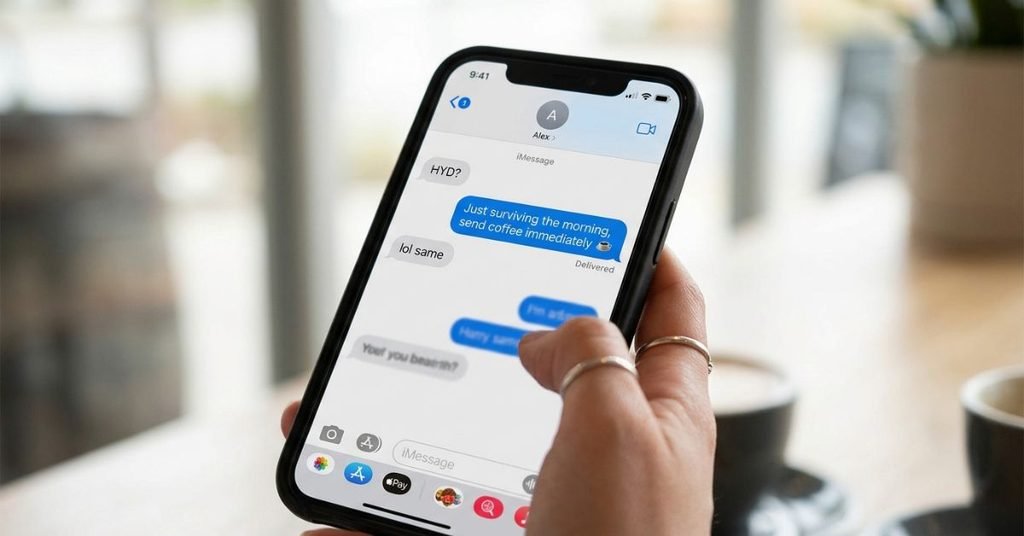
There’s no single “correct” reply — it depends on your relationship and the vibe of the exchange. A few common approaches:
- Keep it simple and honest: “I’m good, just busy with work” — clean, direct, no overthinking required.
- Bounce it back: Answer quickly and return the question — “pretty good, hbu?” — which keeps the conversation moving naturally.
- Match flirty energy if that’s the vibe: Something like “better now that you texted” plays into a romantic or playful tone.
- Go deeper with close friends: If there’s genuinely a lot going on and you’re close with the sender, HYD can be a real invitation to share more than a one-liner.
- Take your time if you’re not that invested: A slower, shorter reply naturally signals lower urgency — and that’s fine, not every HYD needs an enthusiastic response.
Worth noting: how you respond often says as much as what you say. A flat one-word reply can come across as disinterested even when that’s not your intention, while a reply that asks something back signals you actually want the conversation to continue.
Where You’ll Run Into HYD
Texting (SMS/iMessage): The classic setting — used between people who already have some kind of established relationship.
Snapchat: Often used to keep a streak or conversation alive, fired off quickly without much thought, fitting Snapchat’s fast, disappearing-message culture.
Instagram DMs: A common, low-pressure opener between people who follow each other but haven’t talked much directly.
Dating apps: Frequently sent to revive a conversation that’s gone quiet with a match — casual enough not to feel desperate, direct enough to show continued interest.
Discord and gaming spaces: Sometimes used between teammates or server friends after a break in activity.
Generational Differences Worth Knowing
Younger texters — particularly those who grew up with smartphones from their early teens — tend to use HYD almost automatically, without giving it much thought. It’s baked into their default texting vocabulary.
Older millennials and Gen X texters are a bit more selective, often reserving HYD for younger friends, kids, or specifically casual conversations, while defaulting to the fuller “how are you?” everywhere else. For this group, using HYD can feel like a deliberate choice to sound more relaxed rather than pure habit.
Common Ways People Get HYD Wrong
Misreading the tone. Because HYD ranges from purely platonic to subtly flirty, it’s easy to misjudge what someone actually meant. Look at timing, emojis, and history with that person before assuming.
Reading too much into it. On the flip side, plenty of HYD texts really are just casual — not every one deserves a deep-dive analysis.
Using it somewhere formal. HYD has no place in a work email or a message to someone you barely know in a professional setting. Stick with full sentences there.
Assuming everyone knows it. Older relatives, new coworkers, or people outside texting culture might genuinely be confused rather than in on the shorthand.
Ignoring when it was sent. The exact same words sent at noon versus at midnight can carry completely different implications.
Other Things HYD Can Stand For
Outside of texting, the same three letters occasionally pop up meaning something else entirely:
- Hyderabad — HYD is the airport code for Rajiv Gandhi International Airport in Hyderabad, India, and gets used as shorthand for the city in travel and logistics contexts.
- Have You Done — a much rarer regional usage, as in “hyd your homework?”
- Hold Your Day — occasionally seen in scheduling or professional contexts as shorthand for blocking out calendar time.
Context always decides which meaning applies, but in nearly every texting or social-media scenario, “How You Doing” is what’s meant.
The Bottom Line
HYD is a small abbreviation carrying a surprisingly wide range of possible meanings — from a genuine, no-strings-attached check-in to a flirty late-night nudge to a quiet peace offering after a fight. The core definition never changes (“How You Doing?”), but the emotional weight behind it depends entirely on who’s sending it, when, and what history you share.
Next time it shows up in your notifications, you’ll know exactly how to read it — and how to respond in a way that matches the moment.
Frequently Asked Questions
Is HYD always flirty?
No. Most of the time it’s a completely platonic check-in. It only leans flirty depending on who’s sending it, when, and what history you have with them.
Is it rude not to reply right away?
Not really. HYD is low-stakes by design, so a delayed reply usually isn’t a big deal — though going silent for a long time in a close relationship can eventually read as distant.
Can I use HYD at work or in a formal email?
No — keep it out of professional contexts. Stick with “How are you?” when writing to coworkers, clients, or anyone you don’t know casually.
Is HYD the same in every English-speaking country?
The core meaning stays consistent, but how often it’s used can vary a bit by region and age group.
What’s a safe way to respond if I can’t tell what they meant?
A neutral, friendly reply that reciprocates — “I’m good, hbu?” — works in almost any situation until you get more context.
Is HYD different from just saying “hi”?
A little. “Hi” is a plain greeting with no built-in question, while HYD explicitly invites the other person to share how they’re doing, making it slightly more interactive.
