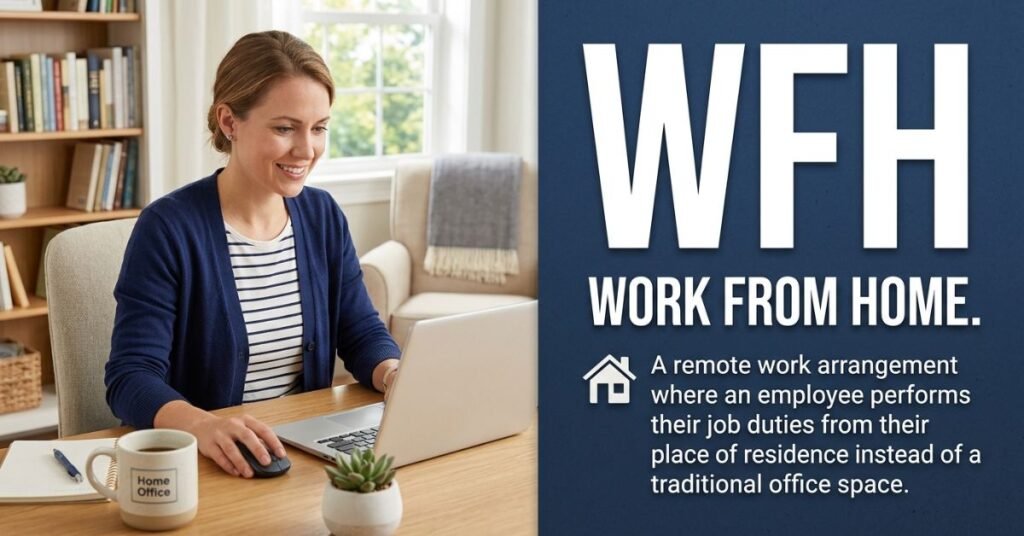
If you’ve spent any time on LinkedIn, scrolled through job listings, or texted a coworker in the last few years, chances are you’ve come across the letters “WFH.” It pops up in calendar invites, Slack statuses, out-of-office replies, and casual conversation. But if you’re new to the term, or just want a clear, no-fluff explanation, this guide covers everything — what WFH means, where it came from, how it’s different from similar terms, and what it actually looks like to live it day to day.
What Does WFH Stand For?
WFH simply stands for “Work From Home.” It describes any situation where someone does their job from their house or apartment instead of commuting to an office, store, warehouse, or other physical workplace set up by their employer.
That’s the dictionary answer. But in real life, WFH has come to mean a lot more than just “not going to the office.” It represents a whole shift in how people think about their careers — how they structure their day, how much control they have over their environment, and how they draw (or blur) the line between personal life and professional responsibilities.
You’ll see the term used in plenty of everyday situations:
- A coworker messages, “I’m WFH today, so let’s hop on a call instead of meeting at my desk.”
- A job posting reads, “This position is fully WFH with quarterly in-person team meetups.”
- Someone blocks their calendar with “WFH — heads down” to signal they’re working but not in the building.
- HR departments now write entire policy documents around WFH eligibility, stipends, and expectations.
Where Did the Term WFH Come From?
Working from home itself isn’t new. Writers, consultants, artists, and small business owners have been doing it for generations — long before laptops and video calls existed. But the term “WFH” as a widely recognized abbreviation really took off in 2020, when the COVID-19 pandemic pushed millions of office workers out of their buildings almost overnight.
Before that, remote work was mostly seen as a rare perk — something offered by a handful of forward-thinking tech companies or granted occasionally as a “work from home Friday.” Many traditional employers were hesitant, worried that without physical supervision, productivity and collaboration would fall apart.
Then the pandemic forced the issue. Offices closed. Zoom and Microsoft Teams became part of daily vocabulary. Dining tables turned into desks, closets became video-call backdrops, and an entire generation of workers learned to do their jobs without ever stepping into a corporate building.
What’s genuinely interesting is what happened after the initial crisis passed. Despite a wave of headlines about companies demanding employees return to the office, remote work never disappeared. Recent labor data shows that roughly one in five American workers — around 34 million people — are still working remotely in some capacity, and that number has barely moved since 2023. Researchers who study this closely, including Stanford’s Nick Bloom, have noted that the shift wasn’t a temporary blip caused by the pandemic — it settled into a lasting new normal for how a large share of the workforce operates.
Even large-scale return-to-office mandates from major corporations have had a surprisingly small effect on the bigger picture. Estimates suggest that if every planned RTO mandate across U.S. businesses were fully enforced, it would only shave off a fraction of a percentage point from the overall share of remote workdays nationwide. In short: WFH isn’t a passing trend. It’s become a permanent thread woven into how modern work functions.
WFH vs. Remote Work vs. Telecommuting vs. Hybrid: What’s the Difference?
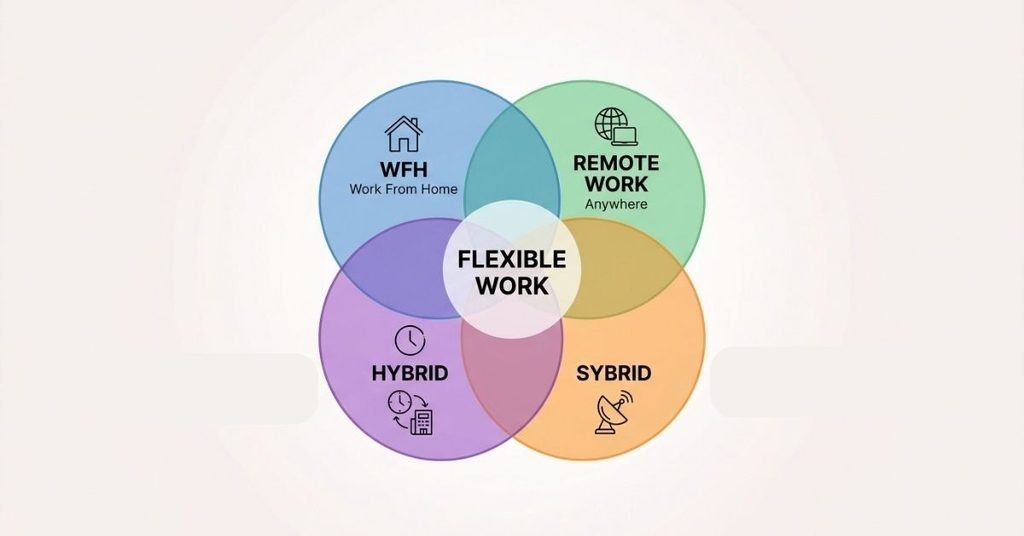
These terms often get used interchangeably, but they don’t mean exactly the same thing.
WFH (Work From Home) is specific — it means working from your actual residence.
Remote work is broader. It doesn’t require being at home specifically; it just means you’re not working from a centralized company location. You could be remote while working from a co-working space, a café, a family member’s house, or a rented cottage in the mountains.
Telecommuting is an older, somewhat outdated term from the 1990s and early 2000s. It described employees who worked from home but stayed connected to the office through phone lines and dial-up internet. You’ll still occasionally see it in older HR handbooks, tax forms, or legal documents, but it’s largely been replaced in everyday speech by “remote work” and “WFH.”
Hybrid work describes a blend — employees split time between working from home and coming into a physical office on designated days, often two or three days a week.
Technically, WFH is a subset of remote work. But in casual conversation, most people use “WFH” and “remote work” as if they’re the same thing, and honestly, that’s fine — everyone understands what you mean.
Why Has WFH Stuck Around Instead of Fading Away?
There’s a fair question worth asking: why hasn’t WFH gone the way of other pandemic-era habits, like banana bread baking or clapping for essential workers at 7 p.m.? A few real reasons explain why it has staying power.
People genuinely don’t want to give it up
Survey after survey shows that employees with remote-capable jobs value the flexibility deeply. Recent research indicates that around three-quarters of workers whose roles could be done remotely are currently doing so at least part of the time, and nearly half say they would seriously consider leaving their job if that flexibility disappeared. That’s not a mild preference — that’s the kind of number that makes company leadership think twice before mandating a full return to office.
The productivity fears didn’t hold up
One of the biggest worries when offices first emptied out was that productivity would collapse without in-person oversight. In practice, that fear mostly didn’t materialize. Numerous workplace studies have found that a large share of remote employees report equal or higher productivity working from home, with fewer interruptions from office chatter, impromptu meetings, and hallway conversations. Some hybrid-work research even points to modest productivity gains compared to fully in-office setups.
It saves real money — for both sides
Employees save on commuting costs, gas, work wardrobes, and daily lunches out. Employers, meanwhile, often save on office space, utilities, and overhead. Some estimates put average annual employer savings per remote worker in the thousands of dollars, which is a meaningful incentive for companies to keep flexible arrangements alive rather than force everyone back under one roof.
The talent pool gets bigger
When a company allows WFH, they’re no longer limited to hiring people who live within commuting distance of a physical office. A business in New York can hire a talented designer in Texas or a skilled developer in another state entirely, all without relocation costs or logistics headaches.
The Real Benefits of Working From Home
Let’s talk about what WFH actually feels like day to day, beyond the statistics.
More control over your schedule. Many WFH roles offer flexibility in structuring your day — starting earlier, taking a longer midday break, or working in a way that fits your natural energy levels rather than a rigid 9-to-5 mold.
No commute. This might be the single most-loved benefit. Skipping a daily commute doesn’t just save time — for many people, it saves an hour or more each day that used to be lost sitting in traffic or squeezed onto a train.
A more comfortable environment. You control the temperature, the noise level, the lighting, and yes, the dress code. For many people, working in a space they’ve personalized leads to better focus and lower stress.
Better work-life integration. Being home means you can throw in a load of laundry between meetings, pick up your kid from school without asking for special time off, or take a short walk to clear your head — things that are much harder to do in a traditional office.
Fewer office distractions. No overhearing every conversation two desks away, no unplanned “got a minute?” interruptions, and no awkward small talk by the coffee machine when you’re trying to focus.
The Real Challenges of Working From Home
WFH isn’t perfect, and pretending otherwise wouldn’t be honest. There are genuine downsides that deserve attention.
Isolation and loneliness. Humans are social creatures, and working alone day after day can feel isolating — especially for people who thrive on in-person interaction and casual office camaraderie.
Blurred boundaries. When your bedroom is twenty feet from your desk, it’s surprisingly easy to answer “just one more email” at 9 p.m., or to feel like you’re never fully off the clock.
Communication gaps. Nuance can get lost over Slack messages and emails. Tone is easy to misread, and quick in-person clarifications that would take thirty seconds in an office can turn into a slow back-and-forth over chat.
Home distractions. Kids, pets, roommates, deliveries, and household chores can pull focus in ways an office environment simply doesn’t allow.
Career visibility concerns. Some employees worry that being physically absent from the office means missing out on mentorship, spontaneous networking, or being “top of mind” for promotions compared to colleagues who show up in person.
WFH is just one of many workplace acronyms that have become common in job listings, emails, and everyday conversation. Here’s a quick-reference table of related terms:
| Abbreviation | Full Form | Meaning |
| WFH | Work From Home | Working from your personal residence instead of an office |
| RTO | Return To Office | A company policy requiring employees to come back to physical office spaces |
| WFA | Work From Anywhere | Full flexibility to work from any location, not limited to home |
| OOO | Out Of Office | A status indicating someone is unavailable, often due to leave or travel |
| FTE | Full-Time Employee | An employee working standard full-time hours, as opposed to part-time or contract |
| PTO | Paid Time Off | Paid leave employees can use for vacation, personal days, or rest |
| EOD | End Of Day | A deadline meaning something is due by the close of the workday |
| COB | Close Of Business | Similar to EOD — refers to the end of the business day |
| ASAP | As Soon As Possible | Indicates urgency for completing a task |
| WLB | Work-Life Balance | The balance between professional responsibilities and personal life |
| BYOD | Bring Your Own Device | A policy allowing employees to use personal laptops/phones for work |
| HR | Human Resources | The department managing hiring, policies, benefits, and employee relations |
| KPI | Key Performance Indicator | A measurable value used to track performance against goals |
| SOP | Standard Operating Procedure | A documented process for completing a task consistently |
| NDA | Non-Disclosure Agreement | A legal agreement to keep certain information confidential |
Knowing these terms helps you navigate modern workplace communication more smoothly, especially in remote or hybrid environments where written communication (emails, Slack, job postings) replaces a lot of face-to-face conversation.
What You Need to Work From Home Successfully
If you’re new to WFH or trying to make it work better, a few essentials go a long way:
- A dedicated workspace — even a small corner of a room helps your brain switch into “work mode.”
- Reliable internet — non-negotiable for video calls and cloud-based tools.
- A comfortable chair and proper desk setup — your back will thank you.
- Clear communication tools — Slack, Microsoft Teams, Zoom, or whatever your company uses.
- Project management software — tools like Asana, Trello, or Notion help remote teams stay aligned without constant check-in meetings.
- A structured routine — start and end times, breaks, and boundaries that mimic the rhythm of an office day.
Tips for Staying Productive While Working From Home
- Set a firm start and end time, even if no one is enforcing it but you. This prevents work from bleeding into every hour of your day.
- Get dressed like you’re going somewhere, even if it’s casual. It’s a small psychological cue that tells your brain the workday has started.
- Take real breaks. Step outside, stretch, eat away from your screen. Burnout creeps in fast when every break involves scrolling your phone at the same desk.
- Over-communicate with your team. In an office, people can see you’re busy. At home, they can’t — so a quick status update prevents confusion.
- Create physical separation between work and personal space if at all possible, even if it’s just closing a door or putting your laptop away at the end of the day.
The Future of WFH: Where Is This Headed?
Despite plenty of headline-grabbing return-to-office announcements, the underlying data suggests remote and hybrid work are here for the long haul. A meaningful share of the workforce — often estimated near a quarter to a third of employees in knowledge-based industries — now works outside a traditional office at least part of the week, and that share has proven far more stable than early predictions suggested.
What’s likely to keep evolving isn’t whether WFH exists, but how it’s structured. More companies are settling into hybrid models rather than fully remote or fully in-office extremes. Businesses are also getting better at building intentional culture and mentorship into remote setups, rather than treating video calls as a poor substitute for in-person interaction.
For workers, this means WFH is no longer a temporary accommodation — it’s a standard expectation many will factor into job searches for years to come.
Final Thoughts
WFH — Work From Home — started as an emergency response to a global crisis and turned into a lasting shift in how millions of people approach their careers. It’s not a perfect arrangement, and it’s not right for every role or every personality. But for a huge portion of the workforce, it’s become the preferred way to work, backed by real data on productivity, retention, and quality of life.
Whether you’re just learning the term for the first time or you’ve been working from your kitchen table for years, understanding what WFH really means — and what it takes to do it well — helps you make the most of the flexibility it offers.
Frequently Asked Questions (FAQs)
Q1. What does WFH mean in texting or chat?
In texting or chat, WFH simply means “Work From Home.” Someone might text “WFH today, ping me on Slack” to let others know they’re working remotely rather than being in the office.
Q2. Is WFH the same as remote work?
Not exactly. WFH specifically means working from your home, while remote work is a broader term that can include working from a co-working space, café, or while traveling — anywhere outside a company office.
Q3. What is a WFH job?
A WFH job is a position that allows or requires the employee to perform their duties from home, either full-time or on certain days as part of a hybrid arrangement.
Q4. Does WFH mean I can work from anywhere in the world?
Not necessarily. WFH usually implies working from your home address. If a role allows working from any location globally, it’s often labeled “WFA” (Work From Anywhere) instead.
Q5. What is the opposite of WFH?
The opposite of WFH is typically “in-office” work, sometimes labeled RTO (Return To Office), where employees are required to work from a company-designated physical location.
Q6. Is WFH still common in 2026?
Yes. Despite various return-to-office mandates from large companies, data shows remote work has stabilized rather than disappeared, with a significant share of the workforce still working from home at least part of the time.
Q7. What skills help someone succeed at WFH jobs?
Strong communication, self-discipline, time management, and comfort with digital collaboration tools (like Slack, Zoom, or project management software) are key skills for succeeding in a WFH role.
Q8. Can WFH affect career growth?
It can, in some cases — remote employees sometimes report reduced visibility for promotions or mentorship opportunities compared to in-office colleagues. However, many companies are actively working to close this gap through structured remote mentorship and clearer performance tracking.


[…] Also Read! WFH Meaning: What Does WFH Stand For? […]
[…] Also Read! WFH Meaning: What Does WFH Stand For? […]